

A quotation that looks cheaper on paper can quietly become the most expensive decision your procurement team makes this year. The problem rarely shows up at the first delivery. It shows up two or three batches later — when the odour profile drifts, when a customer rejects a finished lot, when the certificate you were promised never quite matches the drum in your warehouse, or when the oil you standardised your formulation around is suddenly “out of stock” for six weeks.
Bulk essential oil sourcing isn’t a spot purchase. You’re committing a formulation, a production schedule, and often a regulatory filing to whatever arrives in that drum. Price is the easiest number to compare, which is exactly why it’s the wrong place to start.
This guide walks through what an experienced buyer actually checks before shortlisting a bulk essential oil supplier in India — the specifications, the documents, and the questions that separate a trading contact from a dependable supply partner.
Why Supplier Selection Matters More Than the Lowest Price
Essential oils are natural agricultural products. Two drums both labelled “peppermint oil” can differ in menthol content, botanical source, extraction method and adulteration status — and still both be sold, honestly or otherwise, as peppermint oil. Your supplier is effectively the quality-control layer that sits between the field and your process.
The real cost of a weak supplier isn’t the price per kilo. It’s rejected batches, reformulation, delayed shipments, failed audits, and the internal hours spent chasing paperwork. A supplier who quotes 8% lower but delivers inconsistent material can erase that saving on a single rejected production run.
Reliability has three parts worth naming: technical consistency (does the material match spec, batch after batch), documentation (can they prove it), and commercial dependability (will they actually deliver the agreed quantity, on time). A supplier strong on one and weak on the other two is not a bargain — it’s a risk you haven’t priced yet.
1. Check the Botanical Name and Source
The most common sourcing mistake is treating a common name as a specification. “Eucalyptus oil” isn’t a single product. “Lavender” could mean true lavender, spike lavender or lavandin — three different oils at three different price points and chemistries.
Always work from the binomial botanical name — genus and species. Peppermint is Mentha piperita; the “mentha oil” widely produced in India is often Mentha arvensis, a related but different material. True lavender (Lavandula angustifolia) is not lavandin (Lavandula × intermedia). If a supplier can’t or won’t put the Latin name on the quotation and the certificate, treat that as a signal.
Three things to confirm beyond the name:
- Plant part. Cinnamon bark oil (rich in cinnamaldehyde) and cinnamon leaf oil (rich in eugenol) come from the same tree and behave completely differently. Bitter orange yields three separate materials depending on whether you process the peel, the leaves (petitgrain) or the blossom (neroli).
- Chemotype, where it applies. Rosemary and thyme are sold in distinct chemotypes — for example, rosemary CT cineole versus CT camphor. The species is identical; the chemistry, and the suitability for your application, is not.
- Origin and extraction method. Region and climate shift the natural profile. So does the method: steam distillation, cold expression (typical for citrus), solvent extraction (which gives you an absolute, not an oil) or CO₂ extraction. An absolute and a steam-distilled oil of the “same” botanical are different commercial products.
2. Ask for a COA — and Read It Properly
| A Certificate of Analysis (COA) is a batch-specific document confirming that a particular lot was tested and met an agreed specification. The useful test isn’t whether a supplier can send a COA — it’s whether the COA is tied to the exact batch you’re buying, with a lot number, test date and measured values, not a template full of round numbers. |
A COA worth trusting usually shows:
- Product name, botanical name, plant part and country of origin
- Batch/lot number, and manufacturing plus retest or best-before date
- Extraction method
- Physical parameters — appearance, odour, specific gravity/relative density, refractive index, optical rotation, and where relevant solubility in ethanol and flash point
- Marker constituent(s) with an accepted range — menthol for peppermint, citral for lemongrass, 1,8-cineole for eucalyptus, limonene for orange
- The test methods referenced (ISO, IS/BIS, USP/EP, or a clearly stated in-house method)
- An authorised QC signature
Watch for the generic spec sheet dressed up as a COA. If every batch you’re ever sent carries identical figures, you’re looking at a specification, not an analysis of your material. Ask for the COA of the actual batch on offer — and ask to see COAs from two or three earlier batches so you can judge how tightly they hold their range.
3. Understand What GC-MS Testing Actually Proves
| Gas chromatography–mass spectrometry (GC-MS) separates an essential oil into its individual volatile compounds and helps identify them. It’s the standard tool for checking whether an oil’s compositional profile matches what’s expected for that botanical, and for flagging constituents that don’t belong. |
What GC-MS is genuinely good for: confirming the major and minor constituents fall within expected ranges, comparing a batch against a reference profile, and catching crude adulteration or mislabelling.
What it does not automatically prove: that an oil is “100% pure and natural,” or where it was grown. A skilled adulterator can add cheaper isolates or nature-identical synthetics that mimic the natural profile closely enough to pass a routine read. Distinguishing natural from synthetic, or verifying botanical origin, often needs additional techniques — chiral (enantiomeric) GC, or isotope-ratio methods such as IRMS. The result also depends heavily on the lab, the method, the reference library and the person interpreting the chromatogram.
So treat a clean GC-MS report as necessary, not sufficient — a strong filter, not a guarantee. For high-value or regulated applications, budget for your own independent testing on critical batches rather than relying solely on the supplier’s report.

4. Evaluate Purity and Adulteration Risk
Natural oils vary in price by orders of magnitude, and that gap is exactly what creates the incentive to cut corners somewhere along the chain. This isn’t an accusation about any particular supplier — it’s the basic economics buyers should plan around.
Common issues to be aware of: dilution with a carrier oil or a cheaper oil, “stretching” with synthetic aromatic chemicals or isolates, and substitution of a cheaper species sold under a premium name. None of these is reliably visible in odour or colour.
Practical due diligence:
- Insist on a batch-specific COA plus a GC-MS report for the material you’re actually buying.
- For critical applications, send a retained sample to an independent laboratory.
- Compare COAs across batches to see whether the profile is stable — or suspiciously “perfect.”
- Ask about the chain: is the oil distilled in-house, sourced from known distillers, or bought on the open market? Traceability lowers risk.
The aim isn’t suspicion for its own sake. It’s making sure your specification — not the supplier’s word — governs the transaction.
5. Check Batch-to-Batch Consistency
Some variation is normal and honest. Essential oils are agricultural — harvest timing, weather, region and season all move the numbers. A supplier who promises identical chemistry on every batch, forever, is either standardising heavily or overselling.
What matters is whether the variation stays inside a range you can formulate around. Manufacturers care about this because their finished product — a soap, a perfume, a personal-care line — has to smell and perform the same to the end customer, batch after batch.
How procurement can evaluate it:
- Ask for COAs from several past batches and look at how much the marker constituents actually move.
- Agree a written specification with acceptable min/max ranges rather than a single target number.
- Ask how the supplier handles an out-of-spec batch — do they quarantine it, re-blend to standardise, or simply ship it?
- Where consistency is business-critical, ask whether they can ring-fence stock from a single batch for your production run.
6. Ask About MOQ, Packaging and Storage
These practical details decide whether a supplier actually fits your operation.
MOQ (minimum order quantity) affects cash flow and whether you can run a small trial before committing. A supplier who insists on a full drum before you’ve validated the material is asking you to carry their risk.
Packaging matters for both quality and shipping. Bulk oils typically move in HDPE, aluminium or lined steel drums; smaller quantities in amber glass or lined pails. Oxidation-prone oils — most citrus in particular — benefit from inert (nitrogen) headspace and opaque, well-filled containers. Many essential oils are flammable, which means shipments often need UN-approved packaging and correct dangerous-goods handling. Confirm this before, not after, you place the order.
Storage guidance is part of a serious supplier’s answer: cool, dark, tightly closed, away from heat and air, with a stated shelf life and retest date. If a supplier can’t tell you how to store what they’re selling you, that itself is informative.
7. Evaluate Documentation and Traceability
| Beyond the COA, a bulk essential oil supply usually needs a Safety Data Sheet (SDS), a specification sheet, batch/lot traceability, and — depending on your market and application — an allergen declaration, IFRA conformity and origin documentation. Missing paperwork isn’t a formality; it can stop a shipment at customs or fail an audit. |
Documents a B2B buyer may need :
- COA (batch-specific) and a specification sheet
- SDS/MSDS in GHS format — essential, because many oils are flammable, skin-sensitising or hazardous to aquatic life, all of which affect handling, storage and transport classification
- GC-MS report on request
- Allergen declaration — relevant for EU cosmetics, where constituents such as limonene and linalool must be declared
- IFRA conformity, where the material goes into fragrance
- Country-of-origin documentation and batch traceability
- Application-specific certifications where they apply — food-grade, Kosher/Halal, and so on
You won’t need every document on every purchase. You do need to know which ones your application and destination market require — and to confirm the supplier can produce them before the first shipment, not scramble for them afterwards.
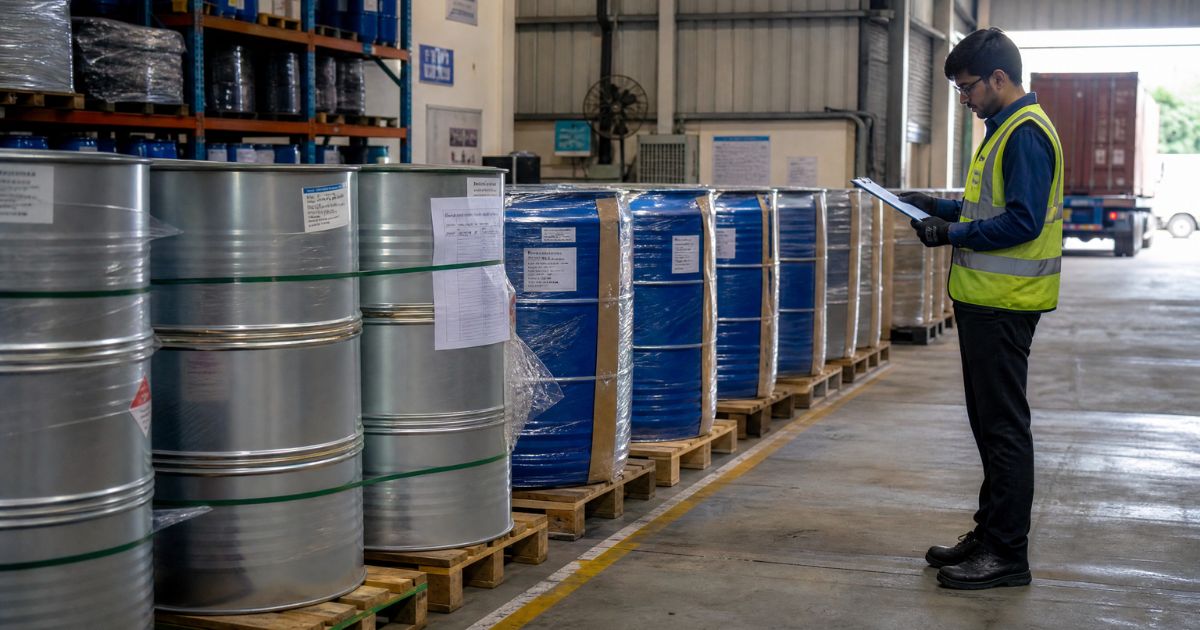
8. Don’t Ignore Export and Logistics Capability
For international buyers, technical quality is only half the decision. The other half is whether the supplier can get the material to you, correctly documented, on schedule.
Points worth pressing on:
- Export experience, and familiarity with the documentation your country requires
- Correct HS classification and dangerous-goods handling (IMDG for sea, IATA for air) where the oil is classified hazardous
- Clarity on Incoterms — FOB, CIF and so on — so cost and responsibility are unambiguous
- Packaging built for the transit mode and climate, not just for storage
- Realistic lead times, and honesty about them
Communication quality is an underrated signal. A supplier who answers technical questions precisely, sends the right document without three reminders, and gives you a straight answer on lead time is showing you how the relationship will run once you’re a paying customer.
9. Compare Suppliers on More Than Price
Put shortlisted suppliers side by side on the factors that actually drive total cost and risk — not just the per-kilo number. This is the kind of comparison worth building once and reusing for every category you source.
| Evaluation factor | What to ask | Why it matters |
|---|---|---|
| Botanical & spec match | Can you supply this botanical name and plant part, meeting this specification? | The wrong species or chemotype quietly breaks your formulation. |
| Batch-specific COA | Is the COA tied to the exact lot I will receive? | A generic template proves nothing about your actual material. |
| Consistency | Can I see COAs from your last few batches? | Shows how tightly the supplier holds spec over time. |
| Documentation | Can you provide SDS, allergen and origin documents? | Missing paperwork stalls customs clearance and audits. |
| MOQ & packaging | What is the MOQ, and how is it packed for shipping? | Decides whether the supplier fits your operation and volumes. |
| Lead time & availability | What is the realistic lead time, and is stock steady? | Protects your production schedule from surprises. |
| Export capability | What Incoterms and dangerous-goods handling do you support? | Determines true landed cost and delivery reliability. |
| Responsiveness | (Observe how they reply during the enquiry stage.) | Predicts how the relationship will actually run. |
A supplier who scores “good enough” across all eight rows usually beats one who is cheapest on price and weak everywhere else.
10. Ask These Questions Before Placing a Bulk Order
A short, direct list you can send to a supplier almost verbatim :
- What is the exact botanical name, plant part and country of origin?
- What extraction method was used?
- Can you send a batch-specific COA and a GC-MS report for the lot on offer?
- What are the acceptable ranges for the key marker constituents?
- Can I see COAs from two or three recent batches?
- What is the MOQ, and how is the material packed?
- What is your recommended storage, and the stated shelf life / retest date?
- Which documents can you provide — SDS, allergen declaration, IFRA, origin?
- What is the lead time, and can you hold stock from a single batch for my order?
- What Incoterms and payment terms do you work with?
If a supplier answers these clearly and without evasion, you’ve learned most of what you need to know.
A Simple Essential Oil Supplier Evaluation Checklist
A one-screen version you can save and run against any supplier before you commit :
| ☐ Botanical name, plant part and origin confirmed in writing
☐ Extraction method stated ☐ Batch-specific COA received and reviewed ☐ GC-MS report available for the offered lot ☐ Marker constituents fall within an agreed range ☐ COAs from earlier batches show stable, believable variation ☐ SDS and any market-specific documents available ☐ MOQ, packaging and shipping method confirmed ☐ Storage guidance and shelf life provided ☐ Lead time, Incoterms and payment terms agreed ☐ Sample approved before any bulk commitment |
What Should You Request Before Your First Bulk Order?
Follow a sequence rather than jumping straight to a purchase order. Each step de-risks the next.
- Sample — request a representative sample and evaluate it against your own requirement, not just by odour.
- Specification — agree a written spec with acceptable ranges for the parameters that matter to you.
- Batch-specific COA — confirm the sample and the offered batch are backed by a matching certificate.
- Technical documentation — collect SDS, GC-MS where needed, allergen/IFRA and origin documents.
- Commercial quotation — get price, MOQ, Incoterms and payment terms in writing.
- Packaging — confirm drum/container type and shipping-appropriate packing.
- Logistics — lock down lead time, shipping mode and responsibilities.
- Final confirmation — only then issue the purchase order.
Skipping steps is how buyers end up with a warehouse of material they can’t use and a certificate that doesn’t match it.
Looking for a Bulk Essential Oil Supplier in India?
Sakha International is a Delhi-based supplier, trader and exporter working with essential oils, aromatic chemicals, perfumery compounds, oleoresins, carrier oils and related specialty raw materials, serving B2B buyers and manufacturers in India and abroad.
If you’re sourcing essential oils in bulk, Sakha International can discuss your required oil, quantity, application and documentation requirements, and share the specifications and paperwork your process and destination market call for.
| Ready to move forward? Request a bulk quotation, ask for a sample, or request a COA for the oil you’re evaluating. Share the botanical name, quantity and intended application so the response can be matched to your requirement.
→ Request a quotation / sample / COA · +91 98100 55405 |
Frequently Asked Questions :
Q1. What’s the difference between an essential oil manufacturer and a supplier or trader in India?
A manufacturer distils or produces the oil; a supplier or trader sources and consolidates material from producers. Both models can serve bulk buyers well — what matters is traceability, documentation and consistency, not the label. Ask where the material originates and how it’s tested, whichever type you’re dealing with.
Q2. How much essential oil counts as a “bulk” order?
There’s no fixed line; it varies by oil and by supplier. Bulk generally starts where material moves in drums or multi-kilo quantities rather than retail bottles. The practical figure is the supplier’s MOQ — ask for it up front.
Q3. Is a GC-MS report enough to confirm purity?
It’s a strong check but not absolute proof. Standard GC-MS can miss sophisticated adulteration and doesn’t verify geographic origin. For critical or regulated applications, combine the supplier’s report with independent testing on key batches.
Q4. What documents should I request before a bulk purchase?
At minimum, a batch-specific COA and an SDS. Depending on your market and application, also request a GC-MS report, allergen declaration, IFRA conformity and origin documentation. Confirm availability before the first shipment.
Q5. Why do prices for the “same” essential oil vary so widely between suppliers?
Because the “same” oil often isn’t. Differences in species, chemotype, plant part, extraction method, purity and origin all move the price — as does adulteration. Always compare like-for-like against a defined specification.
Q6. Should I order a sample before committing to a bulk quantity?
Yes. A sample lets you validate the material against your specification and process before you commit budget and production to it. Skipping this step is a common and avoidable cause of rejected batches.
Q7. Can Indian suppliers handle export documentation and shipping?
Many do, but capability varies. Confirm export experience, Incoterms, dangerous-goods handling and lead times before ordering — especially for oils classified as flammable or hazardous in transit.
By Sakha International — Supplier, Trader and Exporter of Essential Oils, Aromatic Chemicals, Perfumery Compounds and Specialty Raw Materials. Based in Delhi, India, and serving B2B buyers and manufacturers across India and international markets since 2011.


Leave A Comment