
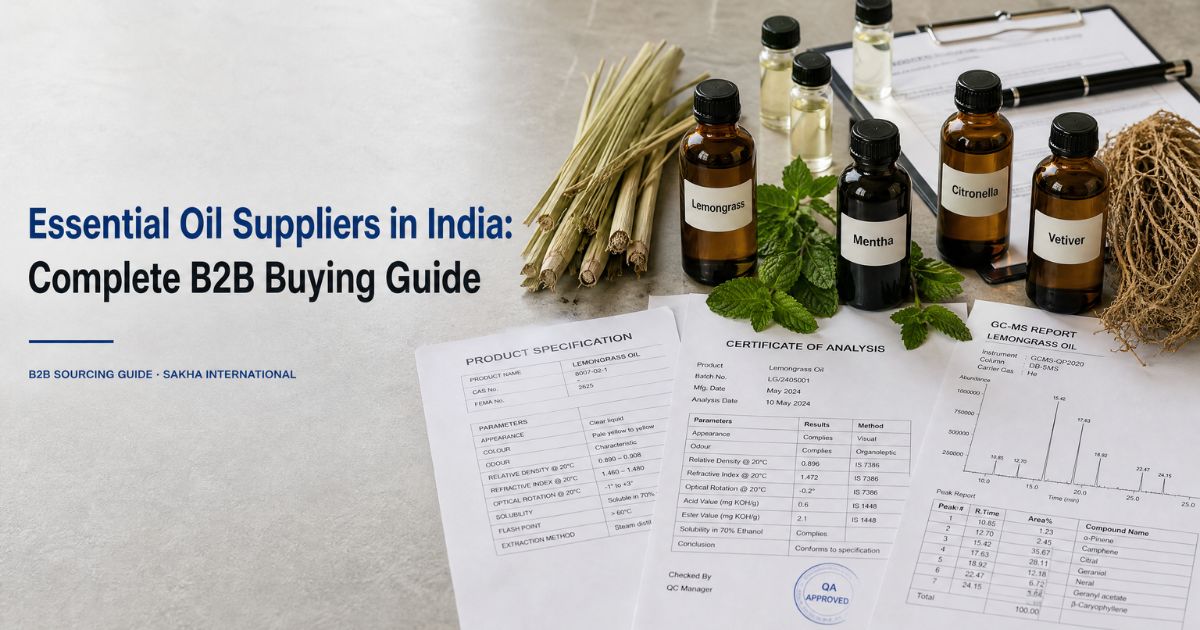
Finding an essential oil supplier is easy. Finding one that ships the exact specification you approved, in the quantity you ordered, with paperwork that survives your QC lab and your customer’s audit — that is the harder problem, and it is the one that quietly costs manufacturers money when it goes wrong.
A single off-spec batch can force a reformulation, delay a production run, or fail an inbound goods check at a client’s warehouse. For exporters, a missing document can hold a consignment at port. Most of these problems are avoidable at the sourcing stage, before a purchase order is ever raised.
This guide is written for the people who actually make the buying decision — procurement managers, formulators, fragrance and flavour houses, cosmetics and personal-care manufacturers, distributors and international buyers. It walks through how to shortlist an Indian essential oil supplier, how to read a quality document, what to standardise across quotations, and how to move from a first enquiry to a repeatable supply relationship. The frameworks below are meant to be used, not just read.
Why India Is Considered for Essential Oil Sourcing
India is a genuine origin for several essential oils rather than only a trading hub, and that distinction matters when you buy. The country has established, at-scale distillation for a specific set of oils, alongside a large network of traders who consolidate and re-export material from other origins. A capable buyer needs to know which category a given oil falls into before comparing prices.
India’s strongest domestic production sits in the mint (mentha) family — it is one of the world’s largest producers of mentha oil and menthol — and in aromatic grasses such as lemongrass, citronella, palmarosa and vetiver. Specialty oils like davana are effectively Indian by origin. For these, a well-run Indian supplier can often offer real single-origin, freshly distilled material with transparent traceability.
For oils that are not primarily grown in India — many buyers ask about lavender, rose, rosemary and similar — India does have emerging cultivation in specific regions, but a large share of what is offered may be traded, blended or reconstituted. That is not automatically a problem; it simply changes the questions you should ask. Always confirm whether you are being offered domestically distilled oil, imported bulk repacked in India, or a standardised blend built to a target profile.
Beyond the raw material itself, buyers typically weigh India for a combination of production depth in the oils above, an established export ecosystem, and the availability of suppliers who can hold specification and documentation to international standards. None of that is universal across every supplier — which is exactly why evaluation matters.
| Buyer takeaway
Separate “origin oils” (mentha, lemongrass, citronella, palmarosa, vetiver, davana) from “traded oils” before you compare quotes. The right questions — and the fair price — differ between the two. |
What B2B Buyers Should Look for in an Indian Essential Oil Supplier
A supplier can have a beautiful website and still be the wrong partner for a manufacturer. What you are really assessing is whether they can deliver the same thing, to the same spec, on a predictable timeline, as your volumes grow. Weigh the following.
- Product range and depth. A broad catalogue is useful, but depth in the oils you actually need matters more. Ask what they distill in-house versus source, and how consistently a given oil is available through the year.
- Specification clarity. A serious supplier can state the specification for an oil — botanical name, key marker compounds, physical parameters — without hesitation. Vague answers here are an early warning sign.
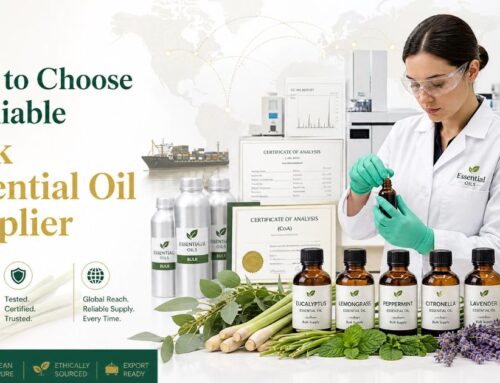
- Quality documentation. Batch-specific COAs and GC-MS reports should be available on request, not treated as an unusual ask. The documentation section below sets out the full list.
- Batch-to-batch consistency. For a manufacturer, consistency is often worth more than a marginally lower price. Ask how they handle natural variation and whether they blend to a target profile to keep formulations stable.
- Communication. Response time and clarity during the enquiry stage tend to predict what after-sales support will look like. Slow, evasive replies before an order rarely improve after payment.
- Packaging. Correct, sealed, appropriately lined containers protect the oil from oxidation and contamination. Ask what packaging comes as standard for your volume and whether export-grade options exist.
- MOQ and supply capability. Confirm minimum order quantities per oil and, importantly, whether they can scale with you. A supplier who suits a trial order may not suit a monthly production requirement.
- Export readiness. If you ship internationally, confirm they routinely handle export documentation, appropriate packaging and agreed commercial terms — not that they are willing to try it for the first time on your order.
Which Essential Oils Can Manufacturers Source in Bulk?
The examples below focus on how each oil is actually used in industry and what a buyer should verify — not on consumer wellness claims. Specifications vary by grade and intended application, so treat these as prompts for your enquiry rather than fixed numbers.
Mint family — peppermint & mentha (menthol mint)
Applications: oral care, confectionery and chewing gum, pharmaceuticals, personal care, and as a source of natural menthol.
Quality considerations: menthol and menthone content define the profile, and there is a real difference between Mentha piperita (peppermint) and Mentha arvensis (menthol mint), as well as between whole oil and dementholised fractions.
Ask about: exact species, menthol content, whether it is natural or partly synthetic/reconstituted, and GC-MS confirmation of the marker compounds.
Lemongrass
Applications: fragrance and soap, home and personal care, insect-repellent formulations, and as a natural source of citral for downstream synthesis.
Quality considerations: citral (geranial + neral) content is the headline specification and drives price.
Ask about: citral percentage, species (Cymbopogon flexuosus vs citratus), and typical batch variation.
Citronella
Applications: insect-repellent products, sanitation and cleaning, candles, and functional fragrance.
Quality considerations: citronellal, geraniol and citronellol content, and the distinction between Java and Ceylon types.
Ask about: type, key constituent percentages, and whether it is single-origin or a standardised blend.
Eucalyptus
Applications: balms and rubs, cleaning products, pharmaceutical and personal-care formulations.
Quality considerations: 1,8-cineole (eucalyptol) content defines pharmaceutical-grade material; Eucalyptus globulus and Eucalyptus citriodora are different oils with different uses.
Ask about: species, cineole percentage, and grade suitability for your application.
Palmarosa, vetiver and davana (India-strong specialties)
Palmarosa is valued for its geraniol content in fragrance and soap. Vetiver (khus) is a fixative and base note in perfumery. Davana is a distinctive Indian specialty used in fine fragrance and flavour. For all three, confirm botanical identity, the relevant marker compound, and traceability of origin, since these are areas where India’s domestic production is a genuine advantage.
Lavender, rose and rosemary — verify origin first
These are frequently requested but are not primarily Indian-grown at scale, though cultivation is expanding in certain regions. Material offered in India may be domestically distilled, imported and repacked, or blended to a profile. None of that disqualifies a supplier — but for these oils in particular, confirm origin, extraction method, and whether you are buying a true single-origin oil, an absolute (solvent-extracted, for rose and similar florals), or a standardised blend.
| A common mistake
Comparing a citral percentage or cineole content across suppliers without confirming they are quoting the same species and grade. Two “lemongrass oils” can be genuinely different products. Anchor every comparison to the botanical name and the marker compound first. |
How to Evaluate Essential Oil Quality
Quality in essential oils is verifiable, not a matter of trust. A responsible buyer builds a small, repeatable evaluation routine and applies it to every new oil and every new supplier. Work through the following.
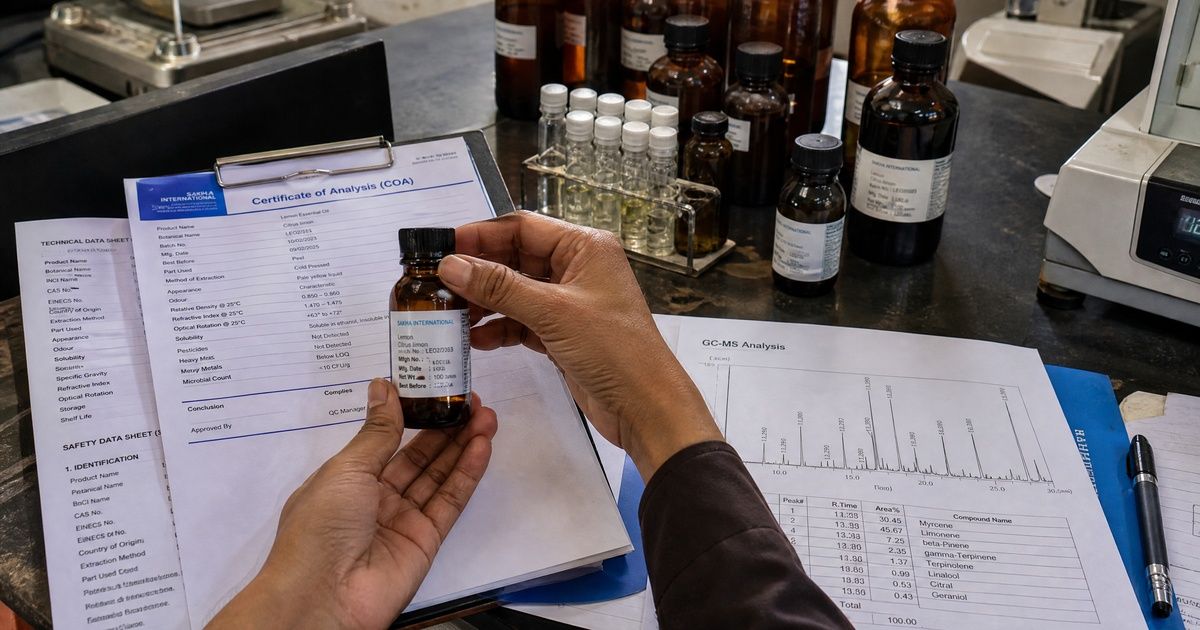
- Botanical identity. Insist on the full Latin binomial (genus and species), not just a common name. “Eucalyptus” or “lavender” alone is not a specification.
- Plant part and origin. The part distilled (leaf, flower, grass, root, wood) and the growing region both affect the profile. Ask for origin and, where relevant, the plant part.
- Extraction method. Steam or hydro-distillation, solvent extraction (absolutes), or CO2 extraction produce different materials. Confirm the method matches what your formulation and regulatory position require.
- Physical properties. Specific gravity, refractive index, optical rotation and solubility are quick, objective checks that should appear on the specification sheet and be reproducible in your lab.
- GC-MS analysis. Gas chromatography–mass spectrometry shows the compound fingerprint of the oil. It is the single most useful document for confirming identity, checking marker-compound percentages, and spotting obvious adulteration or substitution.
- Certificate of Analysis (COA). A batch-specific COA ties the tested values to the actual lot you are buying — not to a generic “typical” profile. Always match the batch number on the COA to the batch you receive.
- Purity and adulteration. Common issues include dilution with a carrier, addition of synthetic constituents, and cross-species substitution. GC-MS plus consistent physical properties is your first line of defence; for critical materials, independent third-party testing is worth the cost.
- Batch consistency. Natural oils vary. What you are checking is whether the supplier controls that variation and can hold your approved profile order after order — ideally evidenced by COAs across several batches, not one.
What Documents Should a B2B Buyer Request?
Ask for these at the enquiry or sampling stage, before an order is confirmed. If a supplier struggles to provide the core documents for a sample, that tells you what a bulk order will look like.
| Document | Why it matters |
|---|---|
| Batch-specific COA | Ties tested values (marker compounds, physical properties) to the exact lot you receive. |
| GC-MS report | Confirms compound fingerprint, identity and marker percentages; flags adulteration. |
| Specification / TDS | States the agreed target profile the supplier commits to meeting. |
| SDS / MSDS | Safety, handling, storage and transport data — required for compliant use and shipping. |
| Allergen declaration | Declares cosmetic allergens present, needed for personal-care and cosmetic labelling. |
| Botanical / origin declaration | Confirms Latin binomial, plant part and origin behind the oil. |
| Organic / specialty certificates | Where claimed — organic, kosher, halal, vegan, non-GMO — request the actual certificate. |
| Export documents | For international orders: certificate of origin, packing list and shipping paperwork, confirmed against your import requirements. |
| Verify, don’t assume
Customs classifications, import permits and country-specific regulatory requirements vary and change. Treat any such detail as something to confirm with your own broker or regulatory advisor — not as fact stated by a supplier or a guide. |
How to Compare Essential Oil Suppliers
Once you have two or three credible options, stop comparing on price alone and score them on the factors that determine total delivered value. The matrix below is a starting template — fill it in from your own sample results, quotations and enquiry experience. Rate each factor simply (for example, Strong / Adequate / Weak) or on a 1–5 scale.
| Factor | Supplier A | Supplier B | Supplier C |
|---|---|---|---|
| Botanical & spec match | |||
| COA + GC-MS provided | |||
| Sample matched approved profile | |||
| Batch consistency evidence | |||
| MOQ fits our volume | |||
| Ability to scale supply | |||
| Packaging quality | |||
| Export readiness | |||
| Communication & responsiveness | |||
| Lead time reliability | |||
| Landed price (all-in) | |||
| Commercial terms |
The value of the matrix is that it forces a like-for-like view. A supplier who is cheapest per kilo but scores “weak” on consistency and documentation is often the most expensive choice once reformulation, QC and delay costs are counted.
MOQ, Pricing and Bulk Packaging: What Buyers Should Consider
The lowest quoted price rarely equals the lowest procurement cost. Price per kilo is only the visible part of what you actually pay.
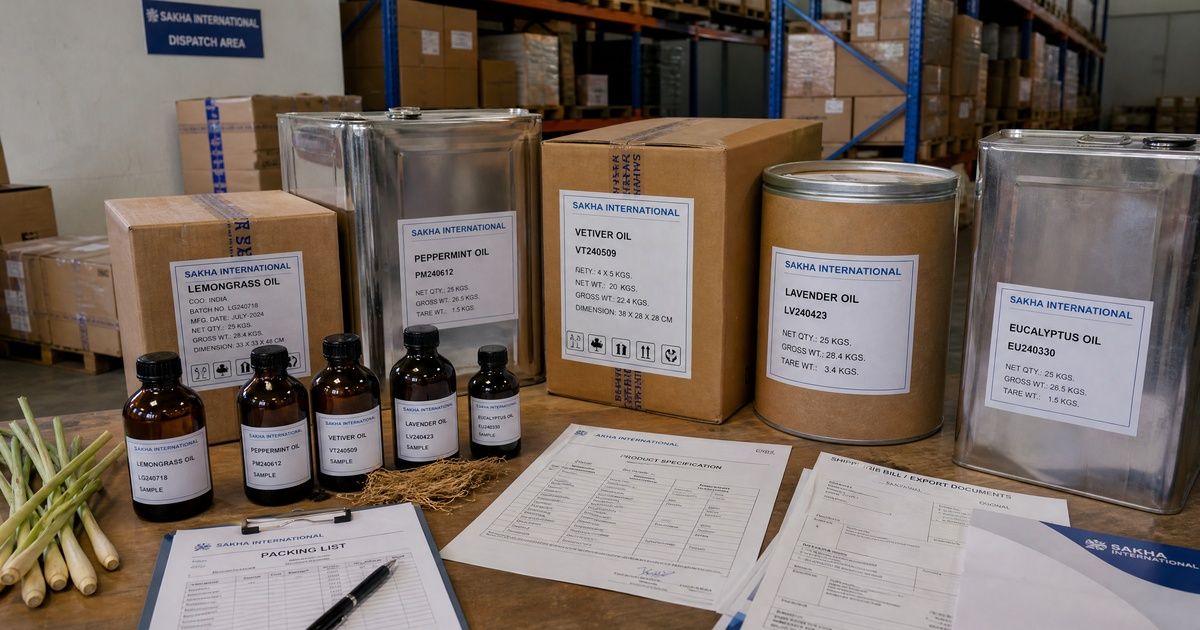
- MOQ vs your real usage. A low MOQ suits trials; a supplier who cannot economically supply your monthly volume will cost you in switching later. Match MOQ to your production reality, not just your first order.
- Consistency has a price too. An inconsistent oil forces reformulation, adds QC hours and risks finished-product failures. A stable, spec-held oil at a slightly higher price is frequently the cheaper option overall.
- Documentation reduces hidden cost. Complete, accurate paperwork saves your regulatory and QC teams time and prevents shipment holds. Poor documentation is a recurring tax on every order.
- Packaging protects the asset. Essential oils oxidise and degrade. Correct, sealed, appropriately lined containers — and, for many oils, awareness of their flammable classification for transport — preserve value and keep shipments compliant. Ask what packaging is standard for your volume.
- Lead-time reliability. A slightly cheaper supplier who misses dates can stall a production line. Predictability is part of the price.
| Total cost of procurement
Landed price + consistency risk + documentation burden + packaging losses + lead-time risk. Score suppliers on the whole figure, not the per-kg line. |
Buying Essential Oils for Export: What International Buyers Should Clarify
If you are importing from India, the goal is no surprises between the approved sample and the delivered consignment. Clarify these before committing.
- Documentation. Confirm which export documents the supplier routinely provides and check them against your own import and regulatory requirements — ideally with your customs broker — before the order ships.
- Packaging for transit. Agree container type, lining, fill volume and labelling suitable for international freight and for the oil’s transport classification.
- Shipment terms. Fix the Incoterms (for example EXW, FOB or CIF) so responsibility for freight, insurance and risk is unambiguous.
- Product specifications. Lock the specification in writing — botanical name, marker compounds, physical parameters — so “as per approved sample” has a documented meaning.
- Sample approval. Approve a reference sample and require that bulk matches it, with a batch COA to confirm. Keep a retained sample of what you approved.
- Commercial terms. Settle payment terms, currency, lead time, and what happens if a batch is off-spec, before the first purchase order.
Questions to Ask Before Choosing an Essential Oil Supplier
- What is the exact botanical name (genus and species) of this oil, and what plant part is distilled?
- Is this oil distilled by you in India, imported and repacked, or blended to a target profile?
- What is the extraction method, and does it match my formulation and regulatory needs?
- Can you provide a batch-specific COA and a GC-MS report for the sample and for bulk?
- What are the key marker compounds and their guaranteed range for this grade?
- How do you manage batch-to-batch variation, and can you hold my approved profile?
- What is the MOQ for this oil, and can you scale to my monthly requirement?
- What packaging is standard for my volume, and what export-grade options exist?
- What is the typical lead time, and how reliable has it been over the last year?
- Which export documents do you routinely provide, and under what Incoterms do you ship?
- What are your payment and commercial terms, including for an off-spec batch?
- Can you share references or evidence of consistent supply to buyers in my industry?
Essential Oil Supplier Checklist
A compact pre-order check. If a prospective supplier clears most of these, they are worth a sample.
- Botanical name and grade confirmed in writing
- Batch-specific COA available
- GC-MS report available
- Specification / TDS provided
- SDS and (where relevant) allergen declaration available
- Sample matches your approved reference profile
- Consistency evidenced across multiple batches
- MOQ and scale-up capacity fit your volume
- Packaging suitable for your storage and shipping
- Export documentation handled routinely (if importing)
- Lead time and commercial terms agreed
- Communication has been clear and prompt throughout
Sourcing Essential Oils in Bulk from India
Sakha International works with manufacturers, formulators and international buyers who need essential oils supplied to a defined specification, with the documentation and consistency that a production or export requirement demands. The most useful first conversation is a practical one.
To move quickly toward an accurate quotation, it helps to share: the oil or product you need, your target quantity, the application it is used in, the documentation you require (such as COA and GC-MS), and whether you would like a sample for approval. From there, the discussion is straightforward — confirm the specification, approve a sample, and agree terms.
| Request a Sample · COA · Bulk Quote
Tell us the oil, the quantity and the application, and we will discuss specification, samples and a quotation. Use the enquiry form, call, or message on WhatsApp to start. |
Frequently Asked Questions :
Q1. What is the difference between an essential oil manufacturer and a supplier in India?
A manufacturer typically distills the oil itself and can speak in detail about crop, plant part and process. A supplier may distill, or may source and consolidate oils from multiple origins. Both can be valid partners — the key is to confirm which role a given company plays for the specific oil you need, because it affects traceability and the questions you should ask.
Q2. How do I verify essential oil quality before placing a bulk order?
Request a batch-specific COA and a GC-MS report, check the physical properties in your own lab, and confirm the botanical name and marker compounds match your requirement. For critical materials, independent third-party testing on a sample — and on the first bulk batch — is worth the cost.
Q3. What is a typical MOQ for bulk essential oils?
MOQ varies widely by oil, grade and supplier, so there is no single figure. Ask for the MOQ per oil and, just as important, confirm the supplier can scale to your ongoing volume rather than only meet a one-off trial quantity.
Q4. Which essential oils is India genuinely known for producing?
India has strong domestic production in the mint family (mentha and menthol), aromatic grasses such as lemongrass, citronella and palmarosa, plus vetiver and specialty oils like davana. For oils not primarily grown in India, confirm whether the material is domestically distilled, imported and repacked, or blended.
Q5. Why is the cheapest supplier not always the best value?
Price per kilo ignores the cost of inconsistency, weak documentation, packaging losses and unreliable lead times. A stable, well-documented oil at a slightly higher price often carries a lower total procurement cost once reformulation and QC time are counted.
Q6. What documents do I need to import essential oils from India?
Core commercial documents usually include a batch COA, SDS, specification sheet, certificate of origin and packing list, alongside standard shipping paperwork. Because import and customs requirements differ by country and change over time, confirm the exact set with your own customs broker or regulatory advisor before shipping.
Q7. Can I request a sample before committing to a bulk order?
Yes — and you should. Approve a reference sample, keep a retained portion of what you approved, and require that the bulk consignment matches it, confirmed by a batch COA. Sample approval is the simplest way to prevent disputes later.
Q8. How should I compare two Indian essential oil suppliers fairly?
Anchor the comparison to the same botanical name, grade and marker compound, then score both on specification match, documentation, consistency, MOQ fit, packaging, export readiness, lead time and all-in landed price. The supplier comparison matrix in this guide is built for exactly that.


Leave A Comment