


Eucalyptus Oil
Sakha International supplies Eucalyptus Oil for international manufacturers, formulators, distributors and bulk buyers. Our focus is consistent, documentation-backed supply: clear species identity, a defined 1,8-cineole grade, and a batch Certificate of Analysis with every consignment. Founded in 2011 and based in Delhi, India, Sakha International works as a manufacturer, wholesaler, distributor, trader and exporter of essential oils, aroma chemicals and perfumery ingredients, serving fragrance, personal care, home care and industrial customers worldwide.
| Product Name | Eucalyptus Oil |
| Botanical Name | Eucalyptus globulus (cineole-type oils; confirm species with Sakha) |
| Plant Family | Myrtaceae |
| Plant Part | Leaves and terminal branchlets |
| Extraction Method | Steam distillation (cineole grades may be rectified) |
| Appearance | Clear, mobile liquid; colourless to pale yellow |
| Aroma | Fresh, camphoraceous, herbaceous, cool and penetrating |
| Key Constituents | 1,8-cineole (eucalyptol); α-pinene, limonene, p-cymene |
| CAS Number | 8000-48-4 (assoc. 84625-32-1); EC/EINECS 283-406-2; FEMA 2466 |
| Eucalyptol (1,8-cineole) | CAS 470-82-6 |
| Origin | To be confirmed by Sakha International |
Eucalyptus oil is the volatile essential oil distilled from the leaves of Eucalyptus trees, an Australian-origin genus in the myrtle family now cultivated across many warm regions including India. The commercially important article is the 1,8-cineole (eucalyptol) type, valued for its clean, fresh, camphoraceous odour. It is one of the highest-volume essential oils in world trade and is used as a fragrance and functional ingredient across personal care, home care, soap and industrial formulations.
Not all eucalyptus oils are the same. The genus has several hundred species, and the distilled oils differ by species and chemotype. E. globulus is the classic cineole-rich blue gum oil and the market default. E. radiata gives a softer cineole profile; E. polybractea is prized for very high cineole; E. citriodora is citronellal-rich and is really a different, lemony article rather than a cineole oil.
1,8-cineole / eucalyptol. This is the constituent buyers most often specify against, because it defines the fresh character and the trading grade. Cineole content varies with species, harvest and distillation, and cineole-type oil is commonly rectified to reach defined grades such as around 70% or 80%. Choose the species and grade to match your formulation rather than assuming a single fixed composition. Exact values are stated on the batch COA.
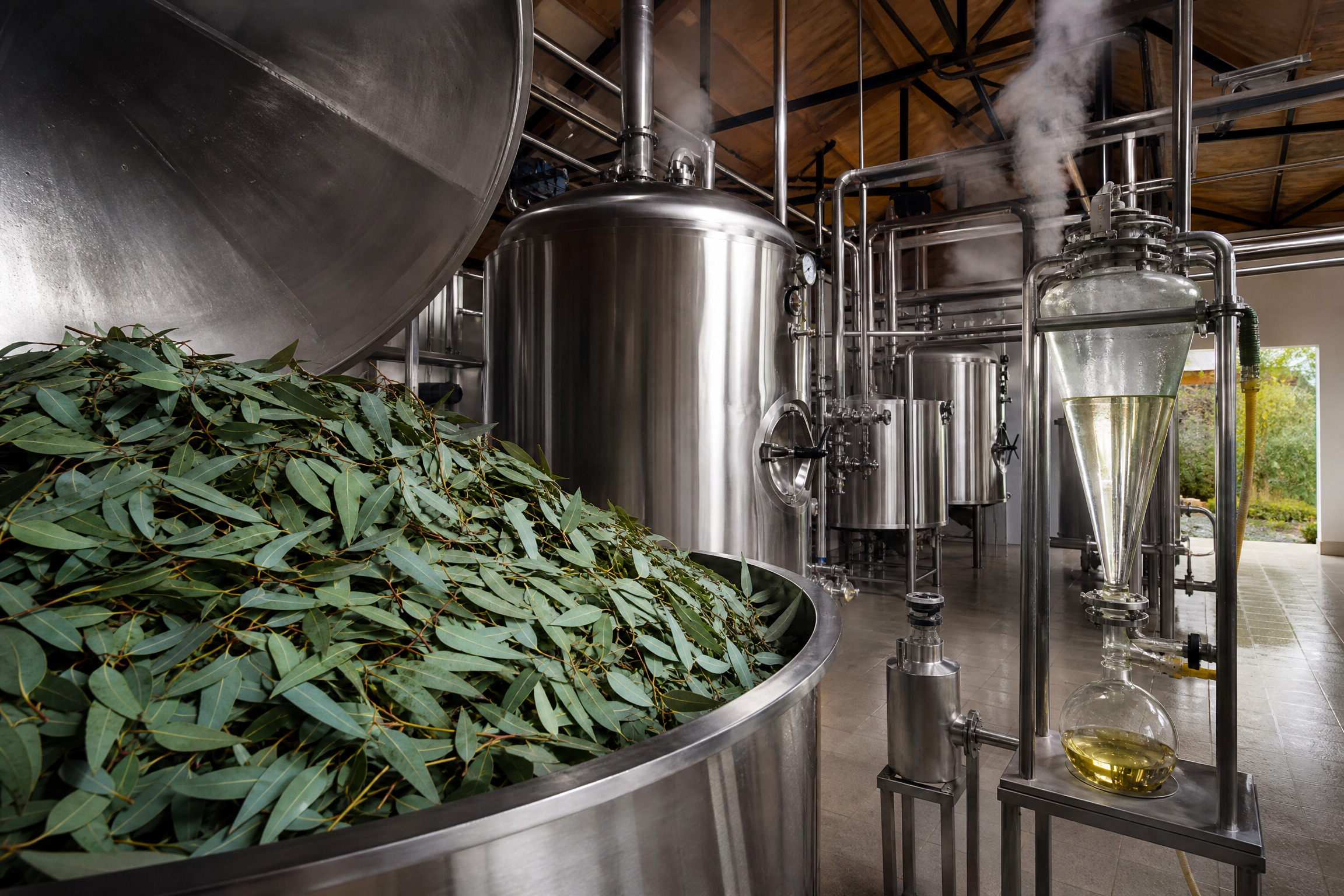
Standard industry practice is steam distillation (hydrodistillation) of freshly harvested eucalyptus leaves and branchlets. The crude distillate can be further purified by fractional or rectified distillation to concentrate 1,8-cineole and remove harsher volatile fractions, which is how higher cineole grades are produced. Sakha International will confirm the exact process and grade for the material supplied against your specification.
- Aroma: fresh, camphoraceous, herbaceous, cool and penetrating; a recognisable top-note character.
- Appearance: clear, mobile liquid, colourless to pale yellow.
- Volatility: high; behaves as a top note and diffuses readily.
- Major constituents: 1,8-cineole dominant in globulus, with α-pinene, limonene and p-cymene as typical secondaries.
- Quality drivers: species identity, cineole grade, absence of adulteration and a clean GC-MS profile.
Fragrance & Perfumery
A classic fresh, camphoraceous top note used in fougère, herbal, spa and “clean/fresh” accords, and to lift masculine and functional fragrances. Compounders should observe IFRA guidance for the relevant application.
Cosmetics & Personal Care
Used as a fresh aromatic and functional note in bath and shower products, hair care, deodorants, aftershave and oral-care flavour bases. Cosmetic use falls under the applicable cosmetic regulations, and label allergen declarations (for example, limonene) should be handled per the finished-product jurisdiction.
Soap & Home Care
A cost-effective, natural-smelling fresh note for bar and liquid soaps, detergents, surface cleaners and disinfectant-style bases where a clean, hygienic scent signal is wanted.
Aromatic Products
Widely used as an aroma ingredient in diffuser and aromatherapy blends, candles, balms and incense, typically combined with lavender, rosemary, pine or citrus oils.
Industrial Applications
Serves as a feedstock for 1,8-cineole isolation and as a fragrance/masking component in industrial cleaners, air-care and technical products. Grade and specification should be matched to the process.
Applications are described at the ingredient/formulation level. This page does not make medical or disease-treatment claims.
Sakha International supports buyer verification with standard documentation. Parameters relevant to eucalyptus oil include:
- Identity: botanical species and plant part; INCI Eucalyptus Globulus Leaf Oil for cosmetic use.
- Organoleptic: appearance, colour and characteristic cineolic odour.
- Physico-chemical: specific gravity, refractive index and optical rotation.
- Composition: 1,8-cineole content and full GC-MS constituent profile.
- Documentation: Certificate of Analysis (COA), Safety Data Sheet (SDS) and Technical Data Sheet (TDS) on request.
ISO reference. For Eucalyptus globulus oil, ISO 770 sets published reference ranges (clear, colourless to pale-yellow oil; relative density 20/20°C 0.906–0.925; refractive index 20°C 1.4590–1.4670; optical rotation 0 to +10°; minimum 1,8-cineole 70%). ISO 3065 covers eucalyptus oils rich in 1,8-cineole. These are standard reference ranges; actual batch values are stated on the COA for the material supplied.
- Store in tightly closed, fully filled containers away from heat, sparks and direct sunlight; the oil is flammable.
- Use inert, compatible packaging (such as HDPE, epoxy-lined steel or aluminium); keep headspace low to limit oxidation.
- Store cool and reseal promptly after sampling; handle with appropriate PPE per the SDS.
- Confirm shelf life and re-analysis interval against the COA and your internal QC policy.
Importers, distributors and manufacturers should confirm the following with Sakha International before ordering: exact species and chemotype; 1,8-cineole grade; country of origin; available certifications; MOQ; packaging and pack sizes; lead time; and export documentation for the destination market. Request a current specification, COA and SDS, and a sample where required, so the material can be validated against your formulation before a bulk commitment.
Established in 2011 in Delhi, India, Sakha International is a manufacturer, wholesaler, distributor, trader and exporter of essential oils, aroma oils, aromatic chemicals and perfumery compounds. The company supplies the air care, personal care, fine fragrance, home care and fabric care industries, and emphasises quality, competitive pricing and documentation-led supply for its international customers.
| Request a Eucalyptus Oil Quotation
Share your target species, cineole grade and volume, and Sakha International will respond with a specification, COA/SDS and a B2B quote. Contact: sakha.international@yahoo.com | +91 98100 55405 | +91 93124 55405. |
1. What species is Sakha International’s eucalyptus oil?
Commercial cineole-type eucalyptus oil is most commonly Eucalyptus globulus. The exact species and chemotype supplied are confirmed by Sakha International on the specification and COA for your order.
2. What is 1,8-cineole (eucalyptol) and why does it matter?
1,8-cineole, also called eucalyptol, is the main constituent of cineole-type eucalyptus oil and defines its fresh, camphoraceous character. Buyers usually specify a cineole grade because it drives odour and suitability for a given application.
3. Which eucalyptus oil grade should I buy?
It depends on the application. Cineole-type oil is traded by 1,8-cineole content (for example around 70% or 80%, with higher rectified grades available). Match species and grade to your formulation and confirm the exact figure on the COA.
4. Do you provide COA, GC-MS and SDS?
Yes. Sakha International supports supply with a Certificate of Analysis, GC-MS profile, Safety Data Sheet and Technical Data Sheet on request so buyers can validate identity, purity and composition.
5. Is eucalyptus citriodora the same as eucalyptus globulus oil?
No. Eucalyptus citriodora is citronellal-rich with a lemony profile and is a chemically different article from cineole-type E. globulus oil. Specify the species you need.
6. What is the minimum order quantity and packaging?
MOQ, pack sizes and packaging are confirmed by Sakha International at quotation, based on grade and destination. Please share your target volume for accurate terms.
7. Which standards and regulations apply to eucalyptus oil?
ISO 770 covers oil of Eucalyptus globulus and ISO 3065 covers cineole-rich eucalyptus oils. IFRA guidance applies to fragrance use and FEMA GRAS 2466 to flavour use; the substance is REACH-registered. Compliance for a finished product depends on its category and market.
8. Can you export eucalyptus oil internationally?
Sakha International is an exporter of essential oils and aromatic ingredients. Export destinations, documentation and lead times are confirmed per order.