
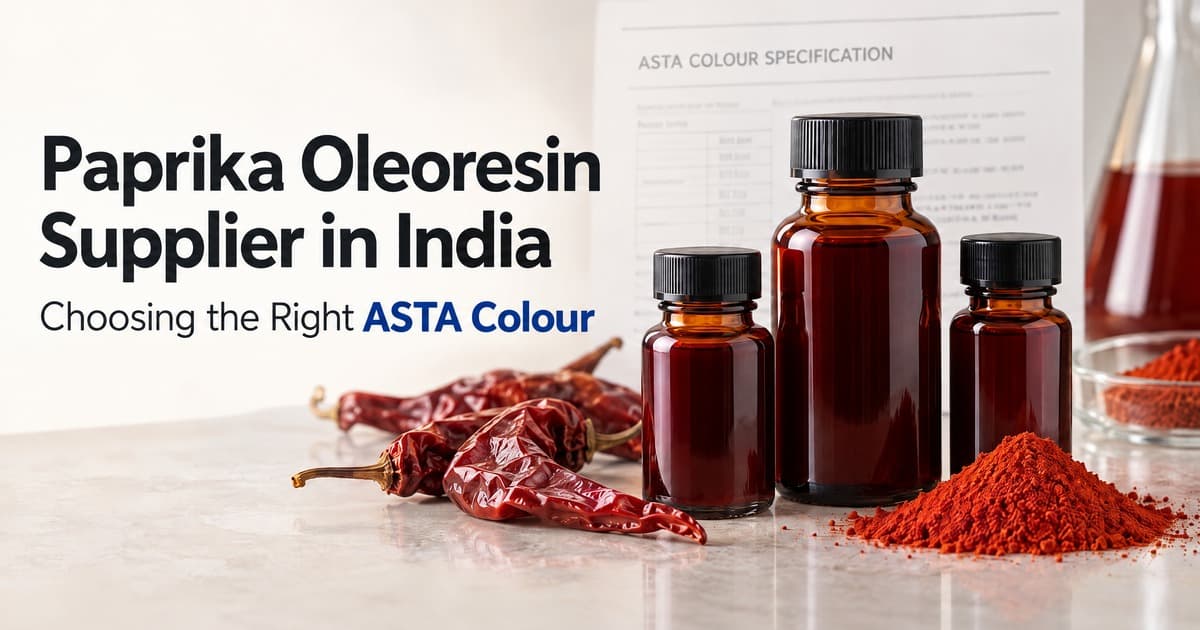
Two drums can arrive labelled “paprika oleoresin” and behave like different ingredients. One colours a sauce a deep, even red at a low dose and holds it through processing; the other looks similar in the bottle but reads oranger in the finished product, needs more material to reach the same shade, or fades faster under light. Both labels are technically correct. The specification behind the name is where the real difference lives — and for a colour ingredient, that difference shows up directly in what your customer sees on the plate.
So the practical question for a buyer is not “what is paprika oleoresin” but “how do I pin down the colour specification my product needs, and how do I choose a supplier who can hold it batch after batch?” This guide works through both: what ASTA colour actually tells you (and what it doesn’t), how to match a specification to your application, and how to evaluate an Indian paprika oleoresin supplier before a bulk order.
Why Paprika Oleoresin Specification Matters
The product name is a category, not a specification. “Parprika oleoresin” tells you the material is a paprika-derived colour extract; it does not tell you its colour strength, its hue, whether it carries pungency, what carrier it’s in, or whether it’s oil-soluble or made water-dispersible. Two suppliers can both answer your enquiry honestly and still ship materials that perform differently in your formulation.
A common procurement mistake is comparing two products by name — or by price per kilogram — while ignoring the specification that determines how much you actually need and how the colour behaves. Once you buy to a defined spec instead of a label, quotes become comparable and the material becomes predictable.
What Is Paprika Oleoresin?
Paprika oleoresin is an oil-soluble colour extract obtained from dried red paprika (Capsicum annuum). It is typically produced by solvent extraction — or by supercritical CO2 extraction — followed by removal of the extracting solvent, leaving a concentrated, viscous, deep-red oleoresin. Its colour comes from naturally occurring carotenoid pigments, principally capsanthin and capsorubin along with related carotenoids.
It is used mainly as a natural colouring ingredient rather than as a flavour or heat source. Colour-grade paprika oleoresin is usually made from sweet (low-pungency) paprika, so pungency is typically low — but it is not automatically zero, which is why any pungency requirement (wanted or to be avoided) should be stated in the spec. This is also where paprika oleoresin differs from pungent oleoresin capsicum: one is standardised for colour, the other for heat. If you’re unsure which you need, decide whether your product is built around colour or around pungency first.
In some markets paprika oleoresin also carries a food-colour designation — in the EU, for example, paprika extract is listed as a natural colour (E160c). Designations, permitted uses and purity requirements differ by country, so confirm what applies in your market with your own regulatory advisor rather than assuming a supplier’s home-market status transfers.
What Does ASTA Colour Mean?
| Answer, in one line
ASTA colour is a standardised measure of the extractable colour strength of paprika and paprika oleoresin, developed by the American Spice Trade Association. A higher ASTA value means greater colouring power — but it describes strength, not the exact shade, and it is not a complete measure of product quality on its own. |
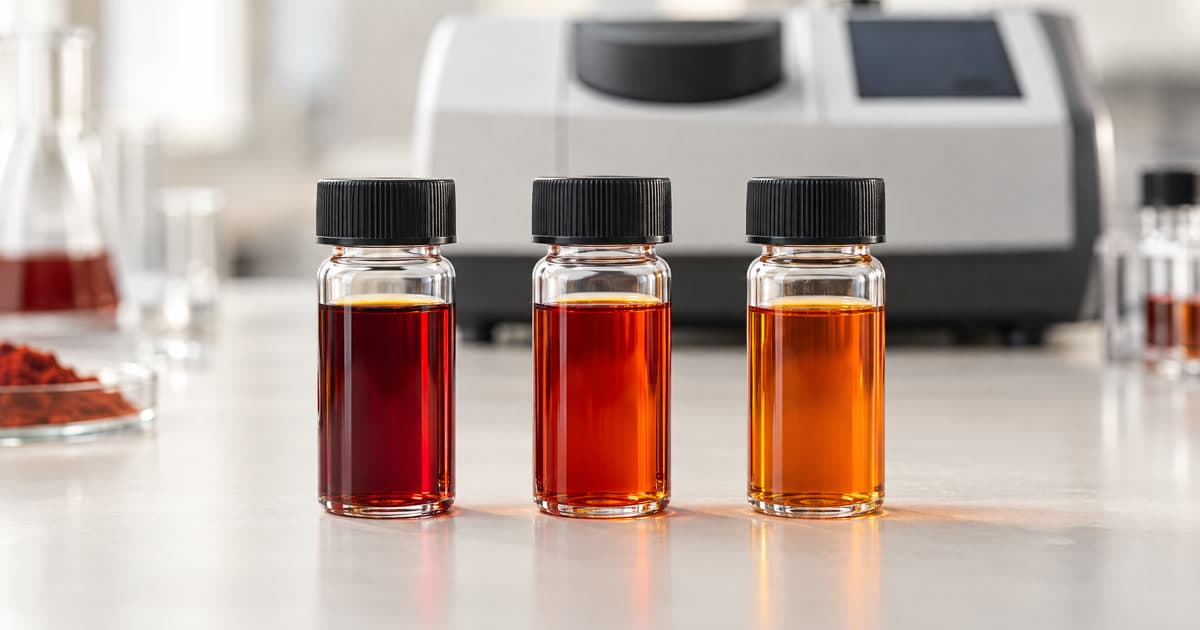
In practice, an ASTA colour value is obtained by extracting the colour from a sample into a solvent and reading its absorbance on a spectrophotometer, then converting that reading to an ASTA figure using the association’s defined method. Because oleoresins are concentrates, they are supplied at a range of standardised colour values, and the right number for you depends entirely on your application and dosage — which is why you should ask each supplier for their exact figure and the method behind it, rather than assuming an industry-standard grade exists.
Three distinctions are worth holding clearly, because conflating them is where colour problems usually start :
- Colour strength is not the same as hue. ASTA measures how much colouring power the material has, not whether it leans red or orange. Two oleoresins at the same ASTA value can produce visibly different shades. If the exact tone matters, specify hue/shade separately or approve it by sample.
- Colour strength is not the same as overall quality. A high ASTA value says nothing on its own about pungency, carrier, solvent residues, stability, or documentation. Quality is the full specification, not a single headline number.
- Lab colour is not the same as in-use colour. The shade and intensity your product actually shows depend on dosage, the food matrix, pH, and exposure to heat, light and oxygen — carotenoids fade over time and under stress. Approve colour in something close to your real formulation, not only against a datasheet.
How to Choose the Right Colour Specification for Your Application
There is no single “best” ASTA value — there is the value that lets you hit your target shade at a workable dose and cost, while staying stable through your process and shelf life. Work backwards from the application.
- Sauces, dressings and marinades rely on even dispersion and stability in a wet, sometimes acidic matrix. Solubility form (oil-soluble vs water-dispersible) and pH stability often matter as much as the raw colour value.
- Seasonings, spice blends and snack coatings need the colour to survive blending, coating and any heat step, and to stay consistent batch to batch so packs look uniform on shelf.
- Processed foods, soups and ready meals involve heat and storage, so heat and light stability and consistent dosing tend to drive the choice.
- Processed meats and dairy-style products are colour-sensitive and closely watched by end customers, so hue consistency and reliable batch-to-batch colour usually come first.
Across all of them, define the parameter you actually control — target shade, acceptable colour tolerance, dose range, solubility form, and any pungency limit — then let the supplier propose the ASTA specification and form that meet it. That order of operations, application first, matters more than any single number.
| Before you request quotes
Write down four things : the shade you’re matching, the food matrix and process it goes through, your acceptable colour tolerance, and any pungency limit. A supplier can quote accurately against that in one pass — and you can compare replies like for like. |
Paprika Oleoresin Quality: What Should Buyers Check?
Check the factors that genuinely affect performance in your product — not a generic list.
- Colour specification. The ASTA colour value and the tolerance around it, plus the test method, so you know exactly what “on-spec” means.
- Hue / shade. The red-to-orange tone, specified or approved by sample, since ASTA alone doesn’t fix it.
- Pungency, where relevant. Whether the material is essentially non-pungent or carries measurable capsaicinoids — relevant if your product must avoid (or requires) heat.
- Carrier and solubility. The diluent used and whether the material is oil-soluble or water-dispersible/emulsified, matched to your formulation.
- Appearance. Colour, clarity and viscosity consistent with the datasheet and previous batches.
- Documentation. A specification sheet or TDS and an SDS, plus allergen, vegetarian/GMO and other status where you rely on such claims.
- Batch COA. A batch-specific certificate of analysis stating the ASTA value and method for the actual lot, not a generic “typical” figure.
- Batch consistency. Evidence that colour value and hue hold across multiple batches, not just the sample lot.
- Storage. Recommended conditions — carotenoid colours keep best cool, dark and sealed, since heat, light and oxygen drive fading.
- Packaging. Light-protective, appropriately lined containers suited to your volume and shipping, ideally minimising air exposure.
Paprika Oleoresin Supplier Checklist
A compact pre-order check. Clearing most of these makes a supplier worth a sample.
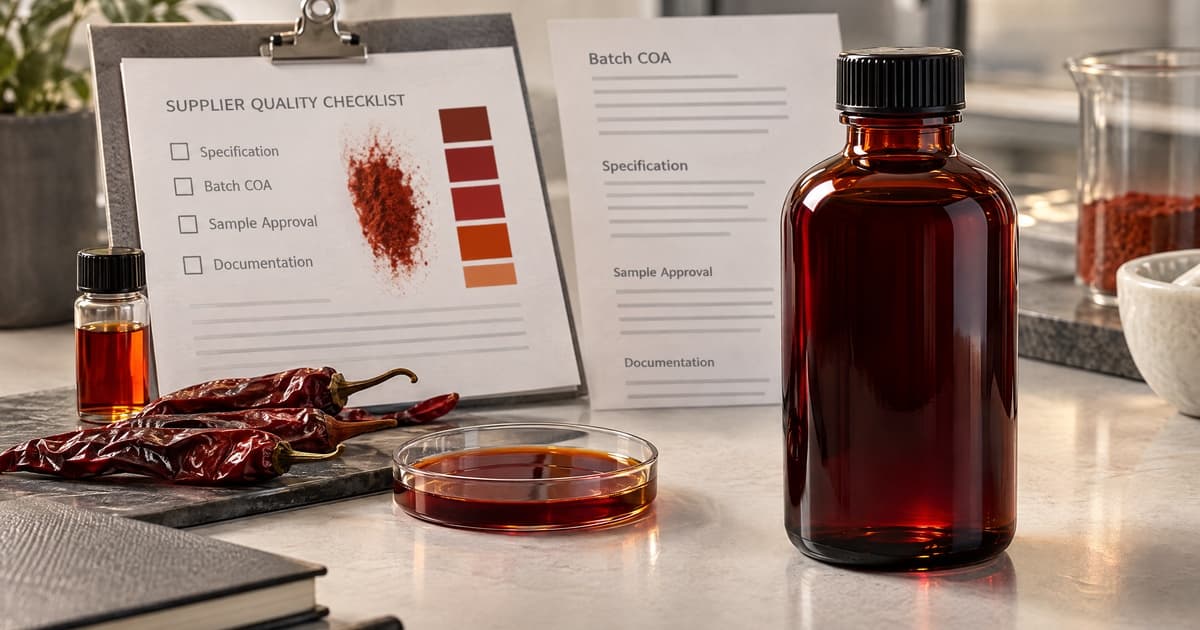
- Colour value (ASTA) and tolerance stated in writing, with method
- Hue/shade defined or approvable by sample
- Pungency status specified (if it matters for your product)
- Solubility form and carrier confirmed for your application
- Specification sheet / TDS and SDS available
- Batch-specific COA provided
- Consistency evidenced across multiple batches
- Food-grade suitability and solvent-residue position clarified for your market
- Storage and packaging appropriate for a light-sensitive colour
- MOQ and ability to scale confirmed
- Sample available to approve before bulk
How to Compare Paprika Oleoresin Suppliers in India
Once you have two or three credible options, compare them on what actually determines delivered value — not just headline price.
| Evaluation factor | What to ask | Why it matters |
|---|---|---|
| Colour value & method | What ASTA value and tolerance, tested by what method? | Defines what you’re really buying and makes quotes comparable. |
| Hue / shade | Can you match or sample-approve my target tone? | Same ASTA can still give a different shade in your product. |
| Pungency | Is this essentially non-pungent, or does it carry heat? | Prevents unwanted pungency — or confirms it if required. |
| Solubility & carrier | Oil-soluble or water-dispersible, and in what carrier? | Determines whether it disperses correctly in your matrix. |
| Consistency | Can you show colour data across several batches? | Batch drift shows up as visible colour variation on shelf. |
| Documentation | Do you provide a batch COA, TDS and SDS? | Needed to verify, handle and clear the material. |
| Stability guidance | How does the colour behave under heat and light? | In-use fade is a common, avoidable surprise. |
| Supply & MOQ | What’s the MOQ, and can you scale with us? | A trial-suited supplier may not fit ongoing production. |
Why Samples and COA Matter Before a Bulk Order
Colour is the one specification you can, and should, verify with your own eyes and your own lab before committing volume. A sensible sequence keeps surprises out of the production run :
- Requirement — define the shade, matrix, tolerance and any pungency limit.
- Specification — agree the ASTA value, hue expectation, solubility form and carrier in writing.
- Sample — obtain a representative sample of the agreed spec.
- Testing / approval — evaluate it in something close to your real formulation, and keep a retained portion of what you approved.
- Quotation — confirm price, MOQ, lead time and terms against the approved spec.
- Bulk order — with each batch backed by a COA you can check against the approved sample.
The COA is what connects every future delivery back to the material you signed off. Without a batch-specific certificate stating the colour value and method, you’re trusting the label — which, for a colour ingredient, is exactly the risk worth removing.
Questions to Ask a Paprika Oleoresin Supplier
- What is the ASTA colour value and tolerance, and by what test method is it measured?
- Can you match my target hue, or approve it against a sample — not just the colour value?
- Is this material essentially non-pungent, or does it carry measurable capsaicinoids?
- Is it oil-soluble or water-dispersible, and what carrier is used?
- Can you provide a batch-specific COA, a specification sheet and an SDS?
- How consistent are colour value and hue across batches, and how do you standardise them?
- What guidance can you give on colour stability under heat, light and storage?
- Is the material suitable for food use in my market, and what is your solvent-residue position?
- What packaging and storage do you recommend for a light-sensitive colour?
- What is the MOQ, and can you scale to my ongoing volume?
Paprika Oleoresin for International Buyers
For import orders, the aim is that the delivered consignment matches the sample you approved — with nothing held up in between. Clarify these before committing.
- Documentation. Confirm which documents the supplier routinely provides — batch COA, specification sheet, SDS and standard export paperwork — and check them against your own import and food-safety requirements, ideally with your customs broker.
- Packaging for transit. Agree light-protective, appropriately lined containers and labelling suited to international freight, so a light-sensitive colour arrives intact.
- Specification confirmation. Lock the ASTA value, tolerance, hue expectation, solubility form and carrier in writing, so “as per approved sample” has a documented meaning.
- Sample approval. Approve a reference sample, keep a retained portion, and require bulk to match it, confirmed by a batch COA.
- Communication. Response speed and clarity during the enquiry stage tend to predict how issues get handled later; treat it as part of the assessment.
- Export coordination. Confirm the commercial terms (including Incoterms), lead time and how an off-spec batch would be handled, before the first purchase order.
Sourcing Paprika Oleoresin from Sakha International
Sakha International works with food manufacturers, ingredient buyers and international buyers who need paprika oleoresin supplied to a defined colour specification rather than a loose product name. The most useful first conversation is a specific one — it gets you an accurate quote in a single pass.
To move quickly, it helps to share: your application and the shade you’re matching, the required quantity, the specification you need (target ASTA colour and tolerance, hue expectation, solubility form and any pungency limit), the documentation you require, and whether you’d like a sample to approve. From there the path is straightforward — confirm the specification, approve the sample against your own formulation, and agree the quotation.
| Request Paprika Oleoresin Sample & COA
Tell us your application, target colour and quantity, and we’ll discuss the right specification, share a sample and COA, and prepare a bulk quotation. Reach us through the enquiry form, by phone, or on WhatsApp. |
FAQs :
Q1. What is ASTA colour in paprika oleoresin?
ASTA colour is a standardised measure of a paprika product’s extractable colour strength, defined by the American Spice Trade Association. A higher value means more colouring power. It tells you strength, not the exact shade, and it isn’t a complete quality measure on its own.
Q2. Does a higher ASTA value mean better paprika oleoresin?
Not necessarily. A higher ASTA value means more colour strength, so you may need less material, but it says nothing about hue, pungency, carrier, stability or documentation. “Better” is the material that matches your application and full specification, not the highest number.
Q3. Is ASTA colour the same as the shade of the colour?
No. ASTA measures how much colouring power the material has, not whether it looks more red or more orange. Two oleoresins with the same ASTA value can give different shades, so specify hue separately or approve it by sample.
Q4. How do I choose the right paprika oleoresin specification?
Start from the application: the shade you’re matching, the food matrix and process, your colour tolerance, the solubility form you need, and any pungency limit. Define those, then let the supplier propose the ASTA specification and form that meet them.
Q5. What should a supplier provide before a bulk purchase?
A clear specification (ASTA value, tolerance and method), a batch-specific COA, a specification sheet and SDS, and a representative sample to approve in your own formulation. For food use, confirm suitability and residue requirements for your market.
Q6. Is paprika oleoresin pungent?
Colour-grade paprika oleoresin is usually made from sweet paprika and tends to be low in pungency, but it isn’t automatically pungency-free. If your product must avoid heat — or requires it — state that in the specification rather than assuming.
Q7. How should paprika oleoresin be stored?
As a general handling matter, it keeps best cool, dark and sealed, because the carotenoid colours fade with heat, light and oxygen. Follow the storage guidance on the supplier’s SDS and specification sheet for the specific grade.
Q8. Can I get a sample and COA before ordering in bulk?
Yes, and for a colour ingredient you should. Approve a representative sample against your real formulation, keep a retained portion, and require each bulk batch to arrive with a COA you can check against what you approved.



Leave A Comment