
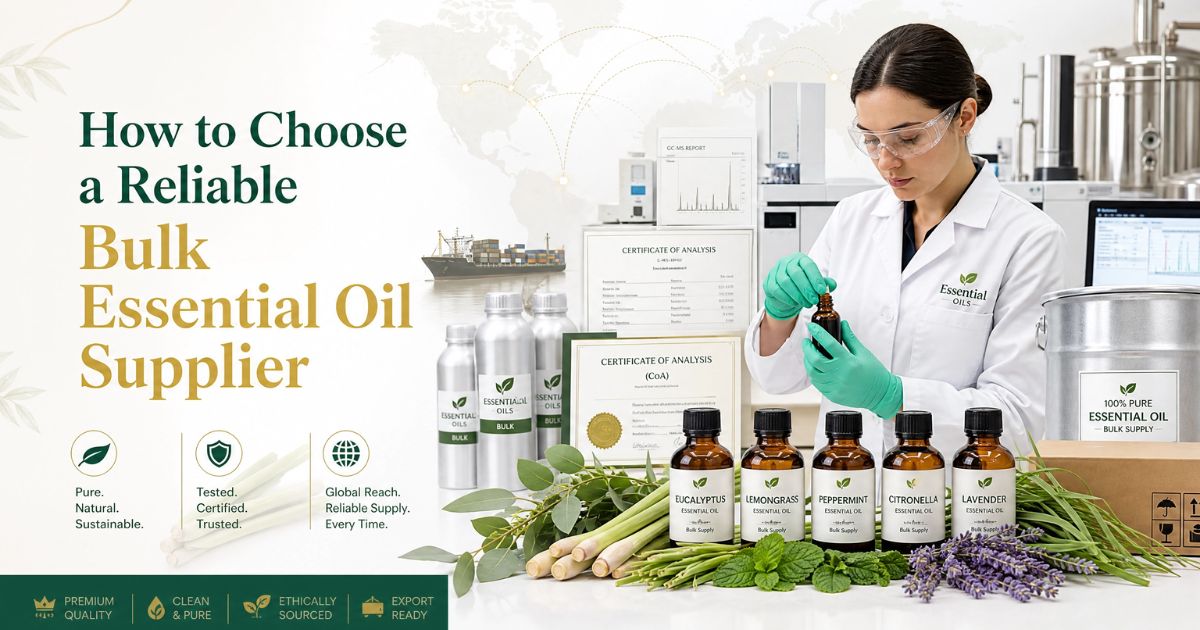
Buying essential oils in bulk is a big commitment. You are not just picking a bottle off a shelf, you are trusting a partner with your product quality, your brand reputation and often, thousands of dollars in inventory. Whether you run a cosmetics line, an aromatherapy business, a pharmaceutical formulation unit or a food flavoring company, the supplier you choose can make or break your operations.
The essential oil market has grown fast over the last few years, and with that growth has come a flood of suppliers, some genuine and some not so much. Finding a reliable bulk essential oil supplier is not always easy, especially when marketing pages all sound the same and every website claims to offer “100% pure” and “therapeutic grade” oils.
The truth is, quality issues, inconsistent batches and unreliable service usually show up only after the order has already been placed. That is why it helps to know the warning signs early, before money and time are on the line. Below are five red flags every buyer should watch for before signing on with a bulk essential oil supplier.
1. No Transparency About Sourcing or Origin
One of the clearest warning signs is a supplier who cannot tell you where their oils actually come from. Essential oil quality depends heavily on the region, climate, soil and harvest season of the source plant. Lavender grown in one belt behaves differently from lavender grown elsewhere, and the same holds true for eucalyptus, citronella, peppermint or lemongrass.
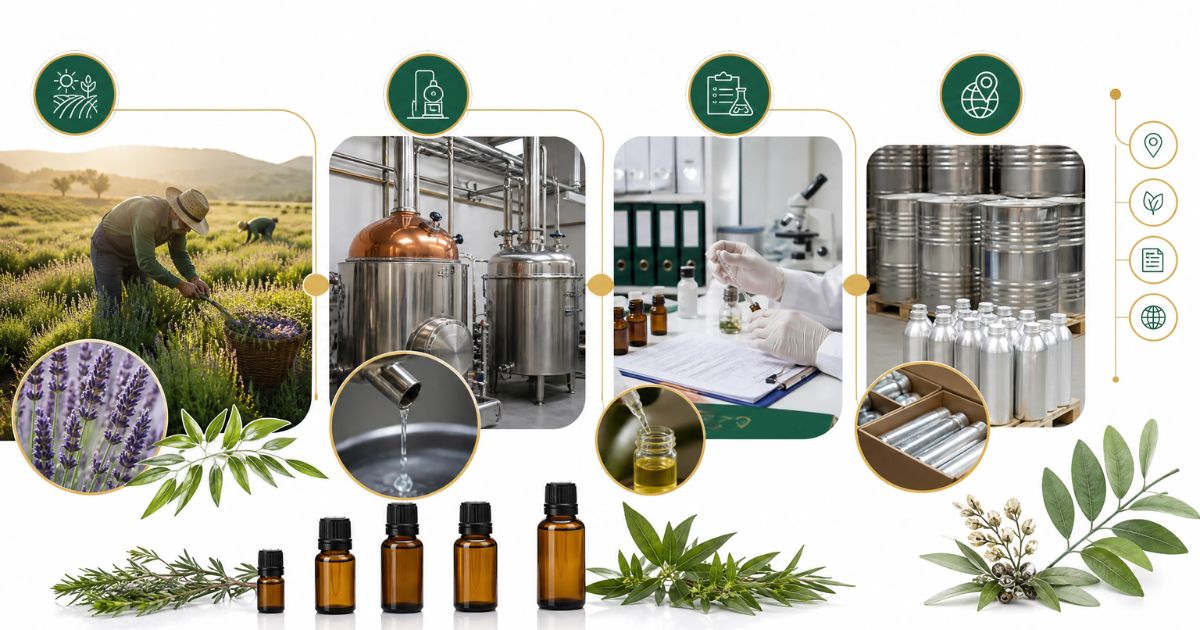
A trustworthy bulk essential oil supplier will happily share details about farm locations, harvest timing, distillation methods and whether the raw material is grown through sustainable, ethical farming practices. If a company gives vague answers, dodges questions about origin, or simply says the oil is “sourced globally” without specifics, that is worth noticing. Genuine exporters are usually proud of their sourcing story because it reflects the effort behind producing a consistent, high quality oil year after year.
Before finalizing any bulk order, ask direct questions. Where is the raw material grown? Who manages the distillation? Is the process seasonal or year-round? A supplier who answers clearly, with specific names and locations rather than general claims, is far more likely to deliver oil that matches what was promised on paper.
2. Missing or Vague Certifications and Lab Reports
Certifications and lab reports are not just paperwork, but proof. A reliable bulk essential oil supplier will provide a GC-MS (Gas Chromatography-Mass Spectrometry) report and a Certificate of Analysis (COA) for every batch, confirming purity and demonstrating that the oil has not been diluted, cut with synthetic compounds or combined with cheaper alternatives to increase the yield.
Beyond batch-level testing, look for suppliers with industry-recognized credentials like ISO 9001, GMP (Good Manufacturing Practices), and organic certifications such as USDA Organic or India Organic (NPOP). These are even more important if you want to sell in international or strict markets as buyers overseas tend to request this paperwork before they release payment.
Some companies fail to disclose any information about the tests conducted for the product, or provide a certificate that is not valid for the batch being delivered. Some websites use logos of accredited companies but do not have any real accreditation at all. A company which has faith in its product will not mind disclosing information before the deal.
3. Prices That Seem Too Good to Be True
Essential oil production is a slow and resource-intensive process. Depending on the plant, it takes hundreds of kilos of raw material to produce a single litre of oil. That’s the reason real essential oils, such as rose, sandalwood or chamomile, have a certain baseline cost that rarely drops much lower than the average cost in the market.
If a bulk essential oil supplier is quoting a price much lower than the rest of the pack, this should be a cause for concern, not celebration. Unusually low prices could mean the oil has been diluted, mixed with synthetic fragrance compounds or made from lower grade raw material. Some sellers even skip the distillation process altogether, which impacts the therapeutic and aromatic qualities of the finished product.
4. Rigid MOQs, No Customization, and Poor Communication
The manner in which a supplier conducts himself/herself before the purchase will tell something about his/her behavior after the purchase. It is not likely that a supplier who responds tardily to your queries concerning technical matters, packaging and delivery schedule will suddenly turn into someone who will respond to your queries promptly once he/she becomes your customer.
Another important thing to consider is the flexibility of the bulk essential oil supplier. The best supplier should be one who is ready to accommodate your requirements in terms of order size and supply more whenever necessary. Those who provide private labeling and packaging help in creating your brand without bottle bottlenecks.
The rigidity of the supplier in terms of order sizes and his/her non-responsiveness to questions about private labeling or packaging is an indication of what you will expect from him/her in the future.
5. Weak Packaging and Inconsistent Batches
Essential oils are sensitive to light, heat and air, and poor packaging can undo good sourcing and distillation work within weeks. Reliable suppliers use dark glass bottles, amber or cobalt blue, for smaller batches, and food-grade aluminium containers with leak-proof, sealed caps for larger bulk shipments. Weak or generic packaging is a sign that quality control stops at the distillation stage and does not extend through storage and transport.
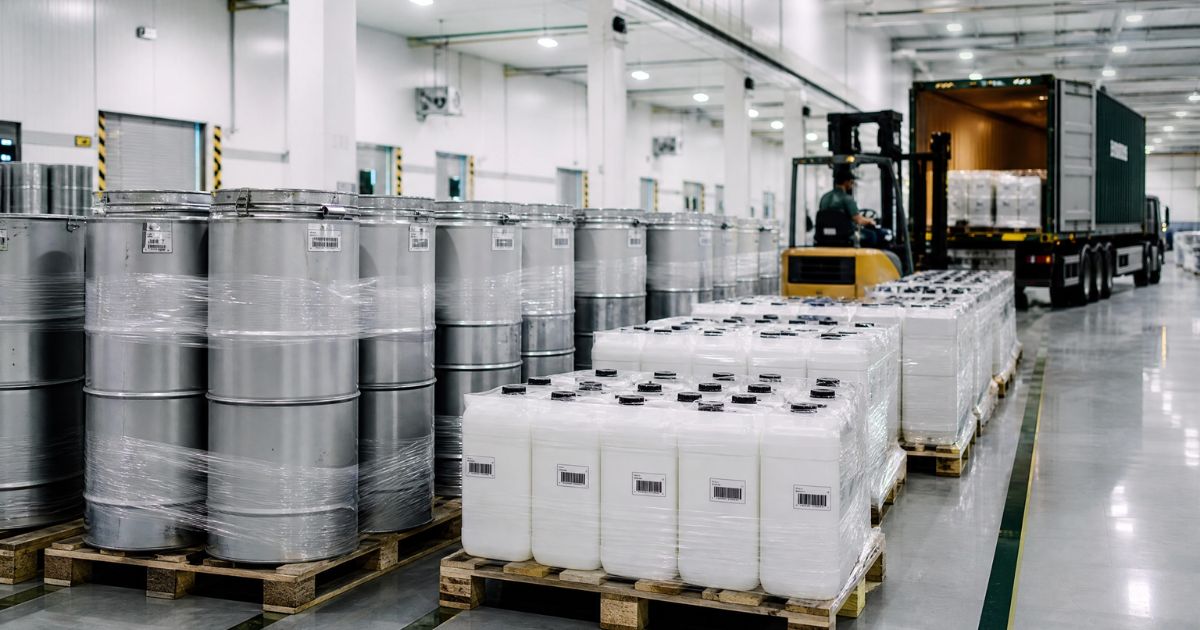
Batch consistency is the other half of this picture. Even genuine essential oils show some natural variation, since they come from living plants affected by weather and harvest timing. But there is a real difference between minor natural variation and a supplier who cannot maintain consistent quality at all. If previous batches varied wildly in color, scent or viscosity, that usually points to deeper problems in sourcing or storage control.
Ask potential suppliers how they manage batch consistency and what packaging they use for bulk orders. A bulk essential oil supplier with proper quality control and protective packaging in place will have clear, confident answers, not guesses.
Choosing the Right Partner
You don’t want to rush into choosing the right partner to source your bulk essential oils. A supplier who is transparent about the origin of the product, offers real certificates and lab documentation specific to the batch, sets a reasonable price, communicates clearly and safeguards quality with appropriate packaging is much more likely to become a long-term, reliable partner than a one-time transaction.
This is the standard Sakha International takes itself to. As a reliable exporter of essential oils, Sakha International maintains full transparency in its sourcing, offers batch-wise GC-MS reports, processes the oils following GMP standards and packs them in export-ready packaging that protects the quality during long shipping routes. Eucalyptus, citronella, lemongrass, peppermint… Every order includes regular testing and a team that responds to the buyers and not to the automatic replies. If you’re looking for a bulk essential oil supplier that ticks all the boxes on this list, Sakha International is happy to share samples, certifications and pricing for your next order.
FAQs :
Q1. What is the major thing that one has to be careful about when selecting a bulk essential oil supplier?
The lack of transparency on sourcing and the lack of laboratory testing or certifications are two of the most important things to keep in mind.
Q2. What certificates does an essential oil supplier need?
Some of the important certificates are ISO 9001, GMP certification, and organic certificates such as USDA Organic or India Organic (NPOP).
Q3. What kind of packaging should be used for bulk essential oils?
The appropriate packaging is dark coloured glass bottles for small shipments and sealed and leakproof aluminium jars for large bulk shipments.
Q4. Should I always request a sample for bulk shipments?
Yes, taking a sample for testing against the requirements is very helpful.
Q5. How can I verify the purity of bulk essential oils before placing a large order?
Request a recent GC-MS report, Certificate of Analysis (COA), and a product sample for testing. A reliable supplier should be transparent about the oil’s botanical name, origin, extraction method, and batch-specific quality reports before you commit to a bulk purchase.
Q6. Why is batch consistency important when buying essential oils in bulk?
Batch consistency ensures that every shipment maintains the same aroma, chemical composition, and quality standards. This is especially important for manufacturers of cosmetics, pharmaceuticals, personal care products, and food flavors, where inconsistent raw materials can affect the final product.
Q7. Can a bulk essential oil supplier provide custom packaging and private labeling?
Yes. Many professional bulk essential oil suppliers offer flexible packaging options, private labeling, and customized order quantities to meet different business requirements. Always confirm these services before placing your order if branding or specific packaging is important for your business.
Q8. What questions should I ask a bulk essential oil supplier before placing an order?
Before placing a bulk order, ask about the oil’s origin, extraction method, batch-wise GC-MS and COA reports, certifications, minimum order quantity (MOQ), packaging options, lead time, export documentation, and quality control process. A trustworthy supplier will provide clear and transparent answers to all of these questions.
These FAQs are highly relevant to your article, strengthen topical authority, and naturally reinforce keywords such as bulk essential oil supplier, GC-MS report, COA, private labeling, MOQ, and quality control without appearing overly optimized.


Leave A Comment