
Every fragrance formulation starts with a sourcing decision. Whether you manufacture perfumes, home care products, personal care lines, or industrial fragrances, the aroma chemicals you procure define the performance, safety, and consistency of your finished goods.
This guide is written for procurement managers, fragrance compounders, importers, and B2B buyers who source – or plan to source – aroma chemicals in bulk from India. It covers what to evaluate, what documentation to demand, and how to build a shortlist of suppliers worth working with.
If you need bulk pricing on aromatic chemicals, request a quotation from Sakha International with your product list, volumes, and destination country.
What Are Aroma Chemicals?
Aroma chemicals are individual odorous compounds – either isolated from natural sources or synthesised in a laboratory – used as building blocks in fragrance and flavour formulations. Unlike essential oils (which are complex mixtures of dozens of compounds), a single aroma chemical is a defined molecule with a specific CAS number, molecular weight, and olfactory profile.
Common categories :
- Terpenoids – linalool, geraniol, citral, limonene
- Musks – synthetic musks such as galaxolide, ethylene brassylate
- Aldehydes – decanal (Aldehyde C-10), undecanal
- Esters – benzyl acetate, linalyl acetate
- Ketones – ionones, carvone
- Lactones – gamma-decalactone, coumarin
- Phenolics – vanillin, eugenol
Industrial applications span :
- Fine fragrances and perfumery
- Personal care (shampoos, lotions, deodorants)
- Home care and fabric care (detergents, air fresheners)
- Incense, agarbatti, and oriental perfumery
- Food and beverage flavouring (food-grade materials only)
- Pharmaceutical and nutraceutical formulations
- Industrial masking agents and masterbatch
Sakha International supplies aromatic chemicals alongside essential oils, perfumery compounds, and solvents – serving buyers across personal care, home care, fine fragrance, air care, fabric care, and spice industries.
How to Identify the Right Aroma Chemical for Your Formulation
Before placing a bulk order, confirm exactly what you need :
- CAS number – the universal identifier. “Linalool” sold by two suppliers may differ in optical isomer ratio; the CAS number (e.g., 78-70-6 for racemic linalool) removes ambiguity.
- IUPAC or trade name – cross-reference against the supplier’s catalogue. Some chemicals are sold under proprietary trade names.
- Grade – perfumery grade, food/flavour grade (FEMA GRAS), cosmetic grade, or technical/industrial grade. The grade determines permissible impurities and regulatory status.
- Natural vs. synthetic vs. nature-identical – this distinction affects labelling claims, pricing, and regulatory classification. Natural isolates command higher prices and may require botanical origin documentation.
- IFRA category – the International Fragrance Association restricts or limits usage levels for many aroma chemicals depending on the product type (fine fragrance, body lotion, household cleaner, etc.). Confirm that your intended use falls within current IFRA Standards.
Procurement tip : Always specify the CAS number, desired purity, and intended application in your RFQ. This eliminates mismatches and speeds up quotation.
Purity, Grades, and Specifications : What to Evaluate
Purity is the single most important quality parameter. It is typically expressed as a percentage by gas-liquid chromatography (GLC/GC) – for example, “Linalool ≥97% by GC.”
Key specification parameters for aroma chemicals:
| Parameter | What It Tells You |
|---|---|
| Purity (% by GC) | Proportion of target compound vs. impurities |
| Appearance | Visual check — colour, clarity, sediment |
| Odour | Characteristic olfactory profile |
| Specific Gravity | Density at a standard temperature (typically 20°C or 25°C) |
| Refractive Index | Optical property confirming identity and purity |
| Acid Value | Degree of free fatty acid or degradation |
| Flash Point | Safety-critical for storage and transport classification |
| Optical Rotation | Relevant for chiral molecules (natural vs. synthetic) |
| Water / Moisture Content | Affects stability and shelf life |
| Colour (Gardner / Hazen) | Numerical colour grading |
What “high purity” actually means varies by compound. Vanillin at 99%+ is standard. Geraniol at 97%+ is considered good quality. Always compare the supplier’s specifications against published pharmacopeia or industry benchmarks — not just against the supplier’s own internal standards.
Certificate of Analysis (COA) : What It Contains and How to Read It
A Certificate of Analysis is the single most important document in bulk chemical procurement. It is a batch-specific quality report issued by the manufacturer or supplier for a defined production lot.
A reliable COA should include :
- Product name and CAS number
- Batch/lot number – links the COA to a specific production run
- Date of manufacture and date of analysis
- Specification column – the acceptable range for each parameter
- Result column – the actual tested value for this batch
- Pass/fail or conformity status for each parameter
- Test methods used (e.g., GC-FID, Karl Fischer titration)
- Name and signature of the QC manager or authorised signatory
- Manufacturer or laboratory identity
How to evaluate a COA critically :

- Check the batch number – it should match the batch printed on the packaging. A generic COA without a batch number is a warning sign.
- Look at actual values, not just “Pass” – a result of 92% purity that “passes” a 90% minimum specification is very different from 99%. Actual numbers let you compare suppliers objectively.
- Verify the test methods – GC analysis is standard for purity. If a COA lists only organoleptic (smell/appearance) testing, it is insufficient for bulk procurement.
- Request third-party COAs when evaluating a new supplier. Independent laboratory testing (from an NABL-accredited lab in India, or equivalent) provides an unbiased verification.
- Retest dates matter – if the COA is older than the stated shelf life or retest period, request a fresh analysis.
Sakha International provides COA-backed quality documentation with its aromatic chemical shipments. When requesting a quotation, ask for a sample COA for each product on your list.
SDS/MSDS and Safety Documentation
Beyond the COA, every aroma chemical shipment should be accompanied by a Safety Data Sheet (SDS), formerly known as the Material Safety Data Sheet (MSDS). The SDS follows the GHS (Globally Harmonized System) 16-section format and provides :
- Hazard identification and GHS classification
- Composition and CAS number
- First-aid, fire-fighting, and accidental release measures
- Handling and storage requirements
- Exposure controls and personal protective equipment (PPE)
- Toxicological and ecological information
- Transport information (UN number, packing group, hazard class)
- Regulatory status
Why this matters for procurement :
- Import clearance – customs authorities in most countries require SDS documentation for chemical shipments.
- Workplace safety – your production facility needs SDS documents for every raw material on-site, as required by occupational safety regulations.
- Insurance and liability – SDS documentation is often required for chemical inventory insurance coverage.
For fragrance compounds (finished blends rather than single chemicals), you should also request an IFRA Certificate of Conformity, which confirms the compound complies with IFRA Standards for the stated product categories.
MOQ, Samples, and the Quotation Process
Minimum Order Quantities (MOQ) for aroma chemicals vary significantly depending on the material, the supplier’s position in the supply chain, and whether the product is a standard catalogue item or a specialty material.
Typical MOQ ranges in India :
- Commodity aroma chemicals (linalool, citronellol, vanillin) : 25 kg, 50 kg, or 200 kg drums
- Specialty or high-value chemicals : 1 kg to 5 kg minimum
- Custom blends or compounds : often 50 kg to 100 kg minimum
Before placing a bulk order :
- Request evaluation samples – a 50 g to 500 g sample allows your perfumer or QC lab to evaluate odour, purity, and suitability before committing to bulk volumes.
- Ask for a sample COA – evaluate quality documentation before the first order.
- Clarify pricing structure – per-kg pricing typically decreases at higher volumes. Ask for price breaks at 100 kg, 500 kg, and 1,000 kg+.
- Confirm lead times – standard items may ship within 3–7 days; specialty products may require 2–4 weeks.
- Establish payment terms – common B2B terms include advance payment for new accounts, with LC or 30-day credit for established relationships.
Contact Sakha International with your product list, target volumes, and delivery location for a bulk quotation.
Packaging, Storage, Shelf Life, and Transport
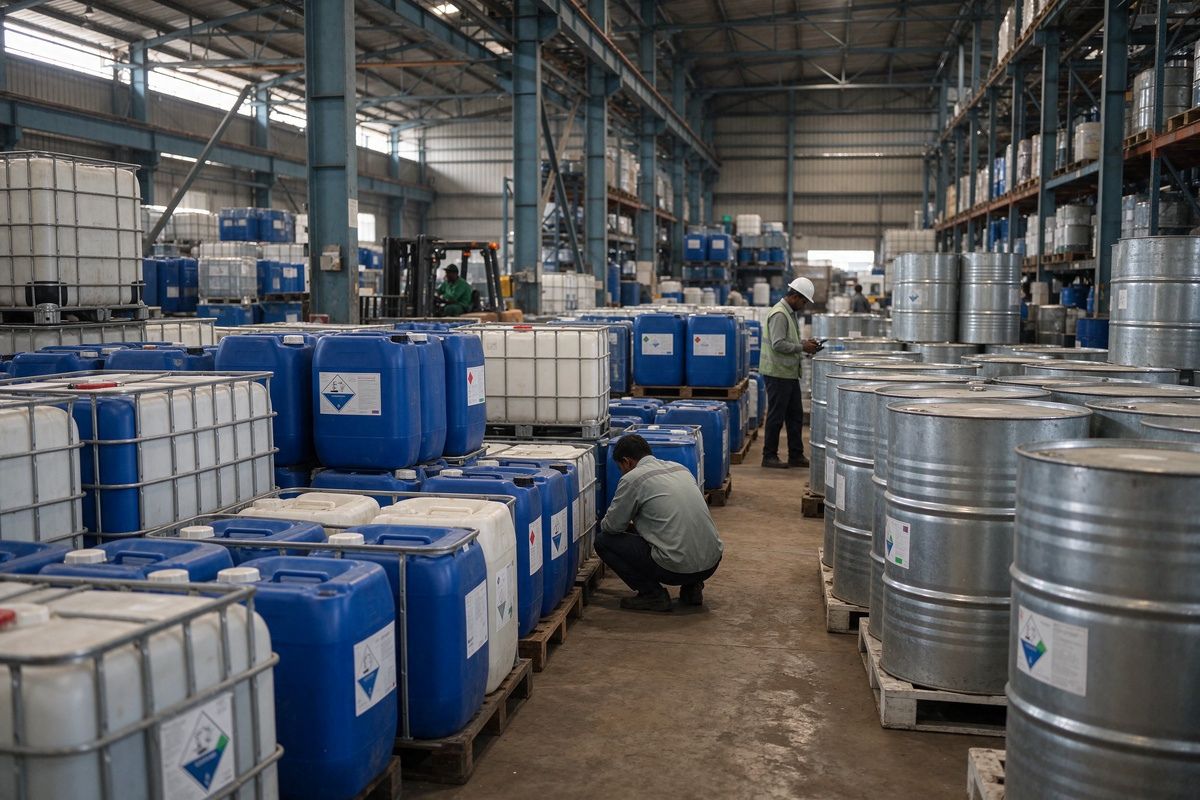
Packaging formats common in bulk aroma chemical supply :
- HDPE jerry cans – 1 kg, 5 kg, 25 kg (suitable for most liquid aroma chemicals)
- GI or MS drums – 50 kg, 100 kg, 200 kg (standard for commodity volumes)
- Aluminium containers – used for light-sensitive or reactive chemicals
- Fibre drums with PE liners – common for solid or crystalline chemicals (vanillin, coumarin, menthol crystals)
Storage considerations :
- Most aroma chemicals should be stored in a cool, dry, well-ventilated area away from direct sunlight.
- Temperature-sensitive materials (e.g., certain aldehydes) may require climate-controlled storage.
- Keep containers tightly sealed – many aroma chemicals are volatile and will lose concentration on exposure to air.
- Shelf life typically ranges from 12 to 36 months depending on the compound. The COA or product specification sheet should state the recommended retest date.
Transport classification :
Many aroma chemicals are classified as flammable liquids (UN Class 3) or may carry other hazard classifications under ADR/IMDG/IATA regulations. Transport documentation must include the UN number, proper shipping name, packing group, and hazard class — all of which appear on the SDS. Domestic transport within India follows the Motor Vehicles Act and associated dangerous goods rules, while export shipments must comply with IMDG (sea) or IATA DGR (air) regulations.
Documentation for Domestic and Export Orders
A reliable aroma chemicals supplier should be able to furnish the following documentation with every shipment :
Standard documents (domestic and export) :
- Certificate of Analysis (COA) – batch-specific, with GC purity, organoleptic notes, and physical constants
- Safety Data Sheet (SDS/MSDS) – 16-section GHS format
- Product specification sheet – including CAS number, IUPAC name, molecular formula, and recommended storage conditions
- IFRA compliance certificate – confirming the chemical meets current IFRA Standards for its intended use category
Additional documents for export orders :
- Certificate of Origin – issued by the local chamber of commerce or export promotion council, required by most importing countries for customs clearance
- REACH Registration or Pre-registration (for EU markets) – confirms the substance is registered under EU Regulation (EC) No 1907/2006; without this, the chemical cannot legally be placed on the EU market above 1 tonne per year
- TSCA Compliance Letter (for US markets) – confirms the substance is listed on the EPA’s TSCA Inventory
- Phytosanitary Certificate – required for certain natural aroma chemicals derived from plant sources
- Fumigation Certificate – may be required for wooden pallets or crates used in sea freight (ISPM 15 compliance)
- Commercial Invoice and Packing List – with HS code classification (Chapter 29 or 33 of the Harmonised System, depending on the chemical)
Buyer’s tip : Request sample documentation before placing a bulk order. A supplier who cannot produce a valid COA or SDS on request is a red flag – walk away.
How to Evaluate an Aroma Chemicals Supplier in India
India is one of the world’s largest producers and exporters of aroma chemicals, with manufacturing clusters in Gujarat (Vapi, Ankleshwar), Maharashtra (Mumbai, Mahad), Uttar Pradesh, and Karnataka. The sheer number of suppliers makes evaluation critical.
Key evaluation criteria :
- Manufacturing vs. trading – Does the supplier manufacture in-house, or are they a trader or stockist? Manufacturers offer better price control, batch consistency, and customisation options. Traders can offer breadth of catalogue but with less control over quality.
- Quality infrastructure – Look for GC-MS and GC-FID analytical capability (in-house or through an accredited third-party lab), ISO 9001 certification for quality management, and FSSAI registration if the chemical is food-grade.
- Regulatory knowledge – Can the supplier speak fluently about IFRA amendments, REACH obligations, and CLP classification? A supplier who treats regulatory questions as afterthoughts is not ready for serious bulk supply.
- Catalogue depth and CAS coverage – A serious supplier maintains a catalogue with CAS numbers, not just trade names. Check whether they stock the specific isomers or grades you need — “linalool” could mean synthetic racemic, natural (ex-Ho wood), or a specific enantiomer.
- Sampling policy – A supplier confident in their product will offer evaluation samples (typically 50 g to 500 g) before expecting a bulk commitment.
- References and track record – Ask for client references, especially from your industry segment (fine fragrance, FMCG, personal care, agarbatti, food flavouring). Longevity in the market matters: the Indian aroma chemicals industry has seen rapid consolidation, and suppliers who have survived multiple IFRA amendment cycles understand the compliance landscape.
- Logistics capability – Domestic reach (can they deliver to your factory location?), export readiness (CHA/freight forwarder relationships, familiarity with port procedures at JNPT, Mundra, or Chennai), and packaging flexibility.
Sakha International (sakhainternational.com) is a Delhi-based aroma chemicals supplier with an extensive catalogue spanning aromatic chemicals, perfumery compounds, and essential oils. Their product range covers major chemical families including terpenoids, musks, aldehydes, esters, and specialty molecules.
Supplier Evaluation Checklist
Use this checklist when shortlisting aroma chemical suppliers for bulk procurement :
| # | Criterion | What to Check | Pass / Fail |
|---|---|---|---|
| 1 | GC purity verification | Can the supplier provide a batch-specific COA with GC purity ≥ 95% (or as specified)? | ☐ |
| 2 | IFRA compliance | Does the supplier confirm compliance with the latest IFRA Standards (currently 51st Amendment)? | ☐ |
| 3 | SDS availability | Is a 16-section GHS-compliant SDS available for every product? | ☐ |
| 4 | CAS number cataloguing | Are products listed with CAS numbers, not just trade names? | ☐ |
| 5 | Sample policy | Will the supplier provide evaluation samples (50 g–500 g) before bulk commitment? | ☐ |
| 6 | MOQ flexibility | Does the MOQ align with your production scale? Can trial orders start at 5–25 kg? | ☐ |
| 7 | Packaging options | Are HDPE, GI drum, aluminium, and fibre drum options available as needed? | ☐ |
| 8 | Domestic logistics | Can the supplier deliver to your factory location with reliable transit times? | ☐ |
| 9 | Export documentation | Can the supplier furnish Certificate of Origin, REACH letter, and TSCA compliance as needed? | ☐ |
| 10 | Regulatory fluency | Can the supplier discuss IFRA amendments, REACH obligations, and CLP classification knowledgeably? | ☐ |
| 11 | Client references | Can the supplier provide references from your industry segment? | ☐ |
| 12 | Payment terms | Are terms competitive (advance, LC, 30-day credit) for your order size? | ☐ |
Scoring guide : A supplier who fails on criteria 1–3 should be disqualified. Criteria 4–8 are strongly recommended. Criteria 9–12 are important for export buyers and large-scale procurement.
RFQ Checklist : What to Include When Requesting a Quote
Sending a well-structured Request for Quotation (RFQ) saves time and signals to the supplier that you are a serious buyer. Include the following in every RFQ :
- Chemical identity – IUPAC name, CAS number, and any trade name you use internally
- Required purity/grade – e.g., ≥ 98% GC, perfumery grade, food grade (FSSAI), pharma grade
- Quantity – Initial order quantity and estimated annual volume
- Delivery location – City and state (domestic) or port and country (export)
- Packaging preference – Jerry can, drum, or bulk tanker; specify material (HDPE, GI, aluminium) if critical
- Documentation required – COA, SDS, IFRA certificate, REACH letter, Certificate of Origin — list everything you need
- Payment terms – State your preferred terms (advance, LC, 30/60-day credit) upfront
- Sample request – Mention if you need an evaluation sample before committing
- Delivery timeline – When do you need the material? Is this a one-time purchase or a recurring requirement?
- Any special requirements – Allergen-free processing, kosher/halal certification, specific isomer requirements, natural origin
Pro tip : Send your RFQ to 3–5 shortlisted suppliers simultaneously. Compare not just price, but responsiveness, documentation quality, and willingness to send samples. The supplier who answers fastest with the most complete documentation often turns out to be the most reliable long-term partner.
Ready to request a quote? Contact Sakha International directly at sakhainternational.com/contact or call +91-512-2370625 to discuss your bulk aroma chemical requirements.
FAQs :
Q1 : What is the difference between aroma chemicals and essential oils?
Aroma chemicals are single, defined molecules (natural or synthetic) with a specific CAS number and consistent purity. Essential oils are complex mixtures of hundreds of compounds extracted from plants. Aroma chemicals offer batch-to-batch consistency and cost predictability that essential oils cannot match, which is why most commercial fragrance formulations rely primarily on aroma chemicals.
Q2 : What is a Certificate of Analysis (COA), and why should I insist on one?
A COA is a batch-specific quality document that reports the results of analytical testing — typically GC purity, specific gravity, refractive index, and organoleptic evaluation. It proves that the specific batch you are buying meets the agreed specification. Never accept a generic or undated COA; it should reference the exact batch number of your shipment.
Q3 : What does IFRA compliance mean for aroma chemicals?
The International Fragrance Association (IFRA) publishes Standards that set maximum usage levels for fragrance ingredients based on safety assessments by RIFM (Research Institute for Fragrance Materials). IFRA compliance means the chemical can be used within the specified concentration limits for its intended product category (e.g., fine fragrance, body lotion, candle). Non-IFRA-compliant ingredients can create regulatory and liability problems for finished-product manufacturers.
Q4 : What is the typical MOQ for bulk aroma chemicals in India?
MOQs vary by supplier and chemical. Common structures are 5–25 kg for trial or evaluation orders, 25–100 kg for small-batch production, and 200 kg+ (full drum) for regular production. Some suppliers offer flexible MOQs for new customers to encourage trial. Always confirm MOQ during the RFQ process.
Q5 : How should I store aroma chemicals to maximise shelf life?
Store in tightly sealed original containers in a cool, dry, well-ventilated area away from direct sunlight and heat sources. Most aroma chemicals have a shelf life of 12–36 months when stored correctly. Check the COA or specification sheet for the recommended retest date. Temperature-sensitive materials (certain aldehydes, some musks) may require climate-controlled storage.
Q6 : Can I get aroma chemicals customised to my formulation needs?
Many manufacturers offer custom synthesis, blending, or concentration adjustment for bulk buyers. This is more common with manufacturers than traders. Discuss your specific requirements — purity targets, isomer ratios, packaging, or blending — during the RFQ process.
Q7 : What export documentation do I need when buying aroma chemicals from India?
Standard export documentation includes a Certificate of Origin, commercial invoice with HS code classification (Chapter 29 or 33), packing list, COA, SDS, and bill of lading or airway bill. For EU markets, you will also need REACH registration confirmation. For the US, a TSCA compliance letter. Plant-derived chemicals may require a phytosanitary certificate.


Leave A Comment