
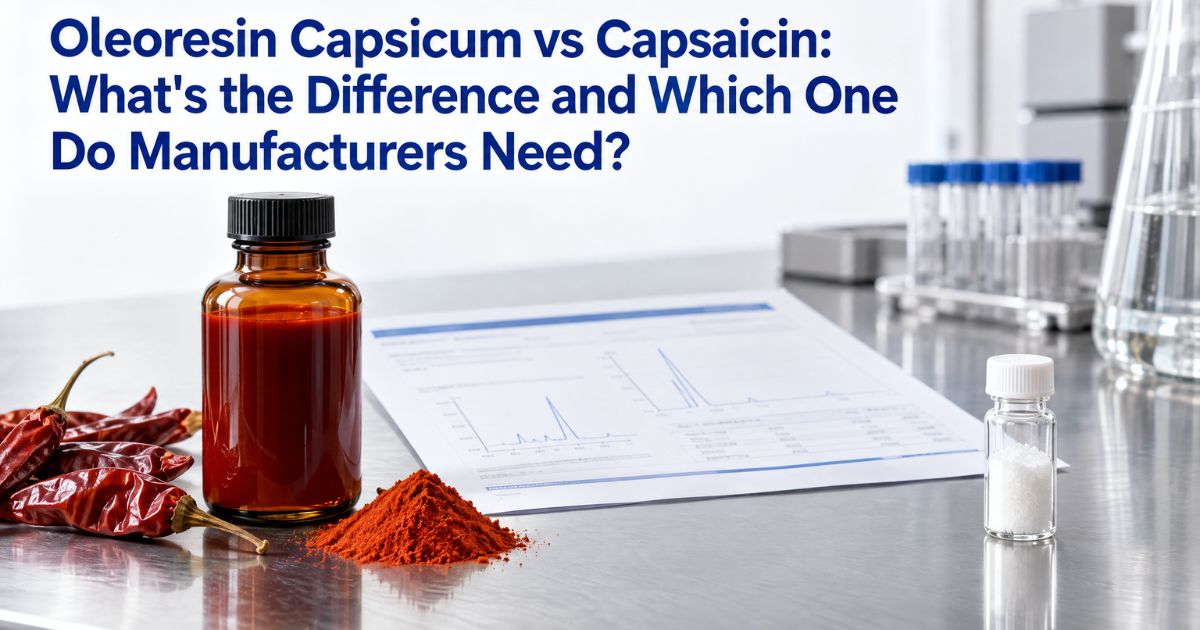
A buyer raises an enquiry for “capsaicin.” The reply comes back as an oleoresin capsicum quotation. Nobody flags the switch, and two different materials — with different compositions, different specifications and different price logic — quietly get treated as the same purchase. The cost of that mix-up rarely shows up on the day. It shows up later: in a formulation that doesn’t behave as expected, a specification the material can’t meet, or an order that doesn’t suit the application it was bought for.
The two names get used loosely across the ingredient trade, which is part of the problem. This article separates them properly — what each one actually is, how each is specified, and, most usefully, how to decide which form your product spec really calls for.
| Quick answer
Oleoresin capsicum is a concentrated, multi-component chili extract in which capsaicinoids sit alongside colour pigments, volatile aroma compounds and other plant extractives. Capsaicin is a single capsaicinoid molecule. They’re related but not interchangeable — and the right choice is decided by your target specification and end application, not by which term is more familiar. |
Oleoresin Capsicum and Capsaicin Are Not the Same Thing
The cleanest way to hold the distinction: oleoresin capsicum is a mixture; capsaicin is a single compound. Oleoresin capsicum is the whole extract pulled out of chili fruit, carrying many constituents at once. Capsaicin is one specific molecule — one member of a family of pungent compounds called capsaicinoids — that can be isolated on its own.
If an analogy helps: oleoresin capsicum is like a whole coffee extract, while capsaicin is like isolated caffeine. The extract owes much of its “heat” to its capsaicinoids, and capsaicin is the most prominent of them — but the oleoresin is far more than its capsaicin content, and buying one is not the same as buying the other.
What Is Oleoresin Capsicum?
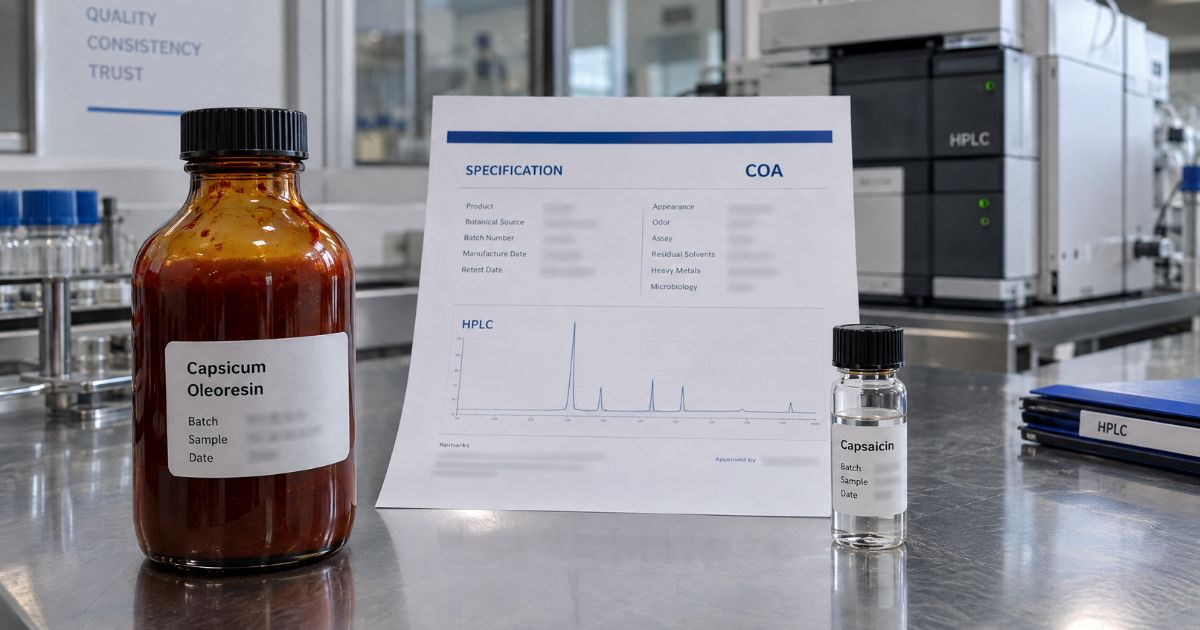
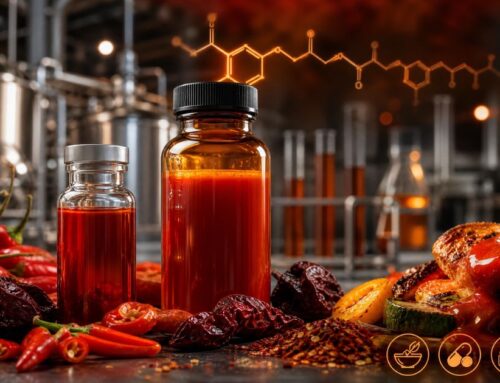
Oleoresin capsicum is a concentrated extract obtained from dried, ground chili fruit (Capsicum species such as Capsicum annuum and Capsicum frutescens). It is typically produced by solvent extraction — or by supercritical CO2 extraction — followed by removal of the extracting solvent, leaving a viscous, oil-soluble oleoresin.
Because it is an extract of the whole fruit rather than a purified molecule, its composition is layered. Alongside the capsaicinoids that carry pungency, it contains carotenoid pigments (which carry colour), volatile aroma compounds, fatty oils and waxes, and other plant extractives. That complexity is exactly why its specification is multi-dimensional rather than a single number.
It also helps to know that oleoresins from capsicum are not one product but a family. Some are standardised primarily for pungency (heat), expressed in Scoville Heat Units or as capsaicinoid content. Others — paprika oleoresins — are standardised primarily for colour, expressed as a colour value. Some deliver a balance of both. A buyer who asks only for “oleoresin capsicum” without saying whether heat or colour is the controlled parameter may not get what the formulation needs. Pungent oleoresins are also commonly standardised or diluted in a carrier to hit a defined heat level, so the carrier and solubility form part of the spec too.
What Is Capsaicin?
Capsaicin is a specific, well-defined chemical compound — one of the capsaicinoids — and it is generally the most abundant of them in chili. But the pungency of a chili, and of an oleoresin, comes from the capsaicinoids as a group, not from capsaicin alone. The second major one is dihydrocapsaicin, with several minor capsaicinoids present in smaller amounts.
This leads to a distinction that causes real confusion in purchasing: “capsaicin” and “total capsaicinoid content” are not automatically the same thing. A certificate of analysis may report total capsaicinoids (typically measured by HPLC), or it may report the capsaicin isomer specifically. Those are different figures. When a specification says “X% capsaicin,” a careful buyer confirms whether that means the single capsaicin molecule or total capsaicinoids expressed as capsaicin. Comparing two quotes without settling this can mean comparing two different measurements.
Isolated capsaicin is specified by purity, usually as an HPLC percentage. It may be isolated from natural capsaicinoids or produced synthetically, so the source and the purity basis are both worth confirming. Isolated capsaicin is also extremely potent — as a reference point, pure capsaicin is often cited at roughly 16 million Scoville Heat Units — which is why it is handled, dosed and specified very differently from a standardised oleoresin.
Oleoresin Capsicum vs Capsaicin: Key Differences
Only scientifically defensible distinctions are included below. Exact values are deliberately left out, because they vary by supplier, grade and application — which is the whole point of specifying carefully.
| Parameter | Oleoresin Capsicum | Capsaicin |
|---|---|---|
| Nature | Complex, multi-component extract (a mixture) | A single, defined capsaicinoid compound |
| Composition | Capsaicinoids + pigments + volatiles + fats/waxes + other extractives | One molecule, supplied at a stated purity |
| Source | Solvent or CO2 extraction of dried chili fruit | Isolated from capsaicinoids or synthesised — confirm source |
| Specification approach | Pungency (SHU / capsaicinoid content), sometimes colour value, plus carrier & solvent-residue limits | Purity % (HPLC); confirm capsaicin isomer vs total capsaicinoids |
| Application considerations | Delivers heat and often colour/aroma; oil-soluble | Delivers concentrated, defined pungency where a specific compound is required |
| Formulation considerations | Standardised/diluted to a target heat; carrier and solubility matter | Very potent; needs precise dosing and stricter handling controls |
| Purchasing considerations | Buy to a heat/colour/carrier spec; grade varies by supplier and use | Buy to purity and source; the label “capsaicin” can be ambiguous |
Which One Should a Manufacturer Choose?
There is no universally “better” option. The right form is simply the one that matches the parameter your finished-product specification actually controls. These decision paths cover the common cases.
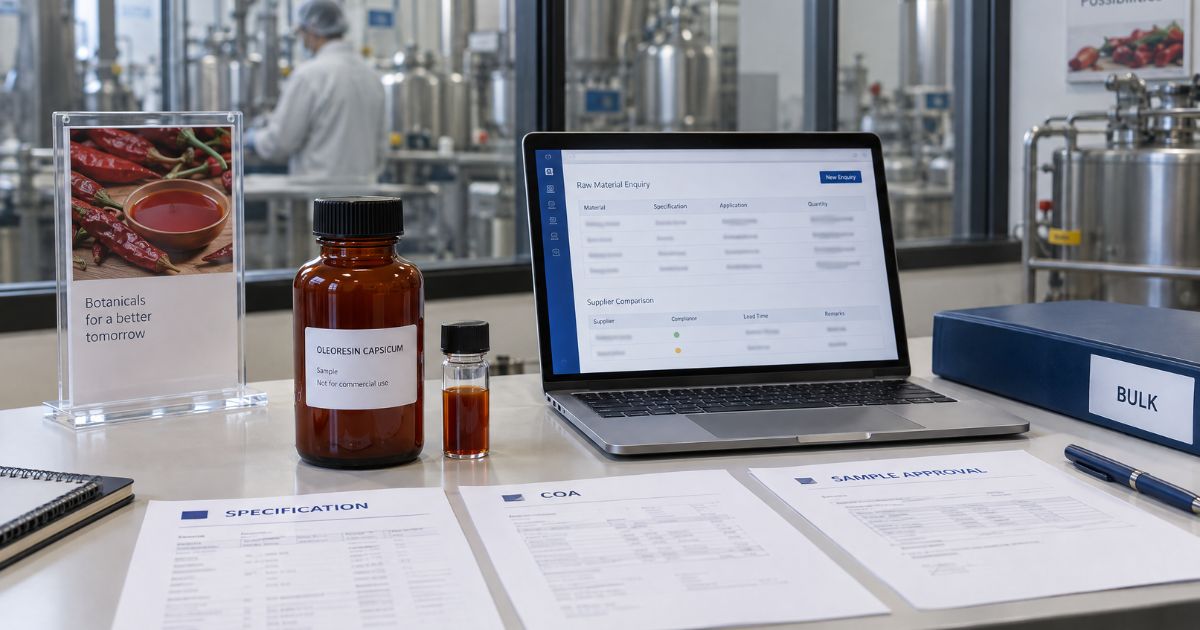
- If your specification calls for a standardised level of heat — possibly with colour — delivered through an oil-soluble ingredient, oleoresin capsicum is usually the form written into ingredient specs.
- If you need a defined, high-purity single compound because your formulation names capsaicin as an active or as a reference standard, isolated capsaicin is the form to source — after confirming whether your spec means the isomer or total capsaicinoids.
- If your process needs colour more than heat, you may actually need a colour-type (paprika) oleoresin rather than a pungent oleoresin or capsaicin at all.
- Before selecting the ingredient, confirm the exact parameter your spec is built on (Scoville level? capsaicinoid percentage? colour value? compound purity?), the carrier and solubility your process requires, and whether “capsaicin” in your internal documents means the isomer or total capsaicinoids.
Answer those first, and the choice between the two usually settles itself.
What Should Buyers Check Before Purchasing Oleoresin Capsicum?
- Specification. The controlled parameter — target pungency (SHU) and/or capsaicinoid content, colour value if relevant, and the carrier or diluent.
- Capsaicinoid basis. Whether the stated content is total capsaicinoids or the capsaicin isomer, and the test method (typically HPLC).
- Documentation. A specification sheet or TDS and a safety data sheet (SDS) appropriate to the material and its handling.
- Batch COA. A batch-specific certificate of analysis that ties the tested values — and the method — to the actual lot you receive, not to a generic profile.
- Sample. A representative sample to approve against your own application before committing to bulk.
- Consistency. How the supplier standardises capsaicinoid content and holds it batch to batch.
- Packaging. Containers that protect an oleoresin from light, heat and air, suitable for your volume and shipping.
- MOQ and scale. The minimum order quantity, and whether the supplier can scale to your ongoing requirement.
- Storage. Recommended conditions — oleoresins generally keep best cool, dark and sealed, since heat, light and air drive degradation.
- Application fit. Whether you need food-grade material, and whether solvent-residue and purity requirements for your use and jurisdiction can be met — confirm the applicable standards with your own regulatory advisor rather than assuming.
Why Specification Matters More Than the Product Name
Across the market, the same handful of names — oleoresin capsicum, OC, capsicum extract, chili extract, capsaicin — get attached to materials that are not equivalent. Two suppliers can both ship you “oleoresin capsicum” and send genuinely different products: different pungency, different carrier, different standardisation, sometimes colour-focused rather than heat-focused. The name alone does not pin down what arrives.
The reliable unit of communication is therefore the specification, not the product name. When you enquire, state the parameter your process controls — for example a target Scoville level, a minimum capsaicinoid content by HPLC, or a colour value — along with the carrier and solubility you need, the application, and any food-grade or solvent-residue requirement. Just as importantly, define the capsaicinoid basis so the capsaicin-versus-total question is settled up front.
Put simply: a product name gets you a quotation; a specification gets you the right material. Suppliers who work with manufacturers expect the second kind of enquiry, and it is the fastest route to an accurate quote.
Questions to Ask an Oleoresin Capsicum Supplier
- Is this a pungency-standardised oleoresin, a colour (paprika) oleoresin, or isolated capsaicin?
- What is the pungency specification (SHU) and/or capsaicinoid content, and by what method?
- When you state capsaicinoid content, is it total capsaicinoids or the capsaicin isomer specifically?
- What carrier or diluent is used, and what is the solubility?
- Is a food-grade version available, and can the purity and solvent-residue requirements for my application be met?
- Can you provide a batch-specific COA, a specification sheet and an SDS?
- How consistent is the capsaicinoid content batch to batch, and how do you standardise it?
- What packaging and storage conditions do you recommend for stability?
- What is the MOQ, and can you scale to my volume?
- Can I approve a sample against my application before placing a bulk order?
Common Buying Mistakes
None of these are exotic — they are the everyday slips that turn a routine purchase into a reformulation.
- Buying on the name alone. “Send capsaicin” or “quote OC” without a spec invites the wrong material.
- Comparing quotes that aren’t comparable. Weighing an SHU-based quote against a capsaicinoid-percentage quote, or total capsaicinoids against the capsaicin isomer, is comparing different measurements.
- Skipping sample approval. A sample confirms the material suits your application before volume is committed.
- Ignoring documentation. Without a COA and its test method, and an SDS, you can’t verify or handle the material properly.
- Assuming every grade is identical. Grade, carrier and standardisation differ between suppliers — “oleoresin capsicum” is a category, not a single fixed product.
- Overlooking storage. Poor storage degrades an oleoresin; the resulting drift in quality is easy to misattribute to the supplier.
How Sakha International Can Help With Bulk Oleoresin Capsicum Sourcing
Sakha International supplies oleoresin capsicum to manufacturers, formulators and international buyers who need it delivered to a defined specification rather than a loose product name. The most productive first conversation is a specific one.
To reach an accurate quotation quickly, it helps to share: your application, the required quantity, the target specification (pungency and/or capsaicinoid content, colour value where relevant, and the carrier), the documentation you need, and whether you’d like a sample to approve. From there the path is simple — confirm the specification, approve the sample, and agree the quotation.
| Request Oleoresin Capsicum Sample · Specification · Bulk Quote
Tell us your application, target specification and quantity, and we’ll discuss the right grade, samples and a quotation. Use the enquiry form, call, or message on WhatsApp to start. |
FAQs :
Q1. What is the difference between oleoresin capsicum and capsaicin?
Oleoresin capsicum is a concentrated chili extract containing capsaicinoids together with pigments, volatile aroma compounds and other extractives. Capsaicin is a single capsaicinoid compound. One is a mixture; the other is a specific molecule. Which you need depends on the parameter your specification controls.
Q2. Is oleoresin capsicum the same as capsaicin?
No. Capsaicin is one of the capsaicinoids present in oleoresin capsicum, but the oleoresin is a multi-component extract, not a purified compound. Treating them as interchangeable in a purchase order is a common and avoidable error.
Q3. How is oleoresin capsicum specified?
Usually by pungency (Scoville Heat Units) or capsaicinoid content, sometimes by colour value for colour-focused types, along with the carrier and solvent-residue limits. Exact figures vary by supplier, grade and application, so the specification should be agreed explicitly rather than assumed.
Q4. Does “capsaicin content” mean the same as “total capsaicinoids”?
Not necessarily. A report may state total capsaicinoids or the capsaicin isomer specifically, and these are different figures. Always confirm the basis before comparing products or approving a specification.
Q5. What should buyers request from a supplier?
A clear specification, a batch-specific COA with its test method, an SDS, and a representative sample to approve against your application. For food use, confirm the applicable purity and residue requirements for your jurisdiction with your own advisor.
Q6. Do I need oleoresin capsicum or a colour (paprika) oleoresin?
If your product is built around heat, a pungency-standardised oleoresin capsicum fits. If it’s built around colour, a colour-type paprika oleoresin is likely the right material. Deciding which parameter your formulation controls answers the question.
Q7. How should oleoresin capsicum be stored?
As a general handling matter, oleoresins keep best in cool, dark, sealed conditions, since heat, light and air accelerate degradation. Follow the storage guidance on the supplier’s SDS and specification sheet for the specific grade.
Q8. Can I get a sample before placing a bulk order?
Yes, and you should. Approving a representative sample against your own application — and keeping a retained portion of what you approved — is the simplest way to make sure the bulk material matches expectations.


Leave A Comment