
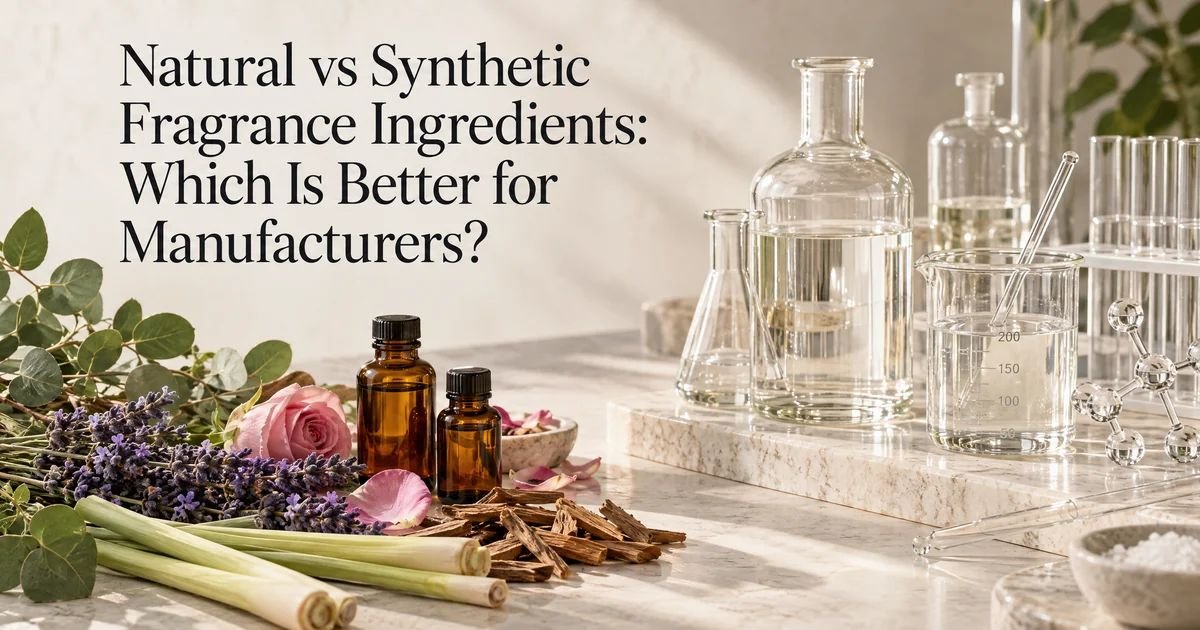
The choice between natural vs synthetic fragrance ingredients is one of the most consequential raw material decisions a fragrance manufacturer, cosmetic formulator or home-care producer will make. It affects aroma quality, batch consistency, regulatory compliance, cost structure and supply chain resilience.
Yet the decision is rarely binary. India’s fragrance ingredients sector benefits from both domestic consumption growth and its established position as a global supplier of natural aromatic compounds, botanical extracts and essential oils. At the same time, the India aroma chemicals market reached USD 299.2 million in 2025 and is projected to grow at a CAGR of 5.02 % through 2034, driven significantly by demand for synthetic specialty molecules.
This article provides an objective, technically grounded comparison of natural and synthetic fragrance raw materials. It is written for procurement professionals, perfumers and manufacturing decision-makers who need to evaluate ingredients on the basis of performance, cost, regulatory standing and supply reliability – not marketing narratives.
Whether you are sourcing essential oils, aromatic chemicals or finished perfumery compounds, the framework below will help you make informed purchasing decisions. If you need a specific ingredient or a custom formulation, discuss your fragrance requirement with Sakha International.
What Are Natural Fragrance Ingredients?
Natural fragrance ingredients are aromatic raw materials obtained directly from botanical, animal or mineral sources through physical or traditional extraction processes. No intentional chemical modification is applied to the extracted material.
How Natural Ingredients Are Obtained
The principal extraction methods include :
- Steam distillation – the most widely used method for producing essential oils (lavender, eucalyptus, peppermint, lemongrass, vetiver)
- Cold pressing (expression) – used for citrus peel oils (orange, lemon, bergamot, grapefruit)
- Solvent extraction – produces concretes and absolutes from delicate florals (jasmine absolute, rose absolute, tuberose)
- CO₂ supercritical extraction – yields high-fidelity extracts without solvent residues
- Enfleurage – a traditional fat-absorption method, now rarely used at industrial scale
- Hydro-distillation and maceration – used for certain resins, gums and balsams (frankincense, myrrh, benzoin)
Examples of Natural Fragrance Raw Materials
| Category | Examples |
|---|---|
| Essential oils | Lavender, peppermint, eucalyptus, lemongrass, clove bud, basil (tulsi), vetiver, chamomile roman, clary sage, camphor |
| Absolutes | Jasmine, rose, tuberose, oakmoss |
| Expressed oils | Orange, lemon, bergamot, grapefruit |
| Resins and balsams | Frankincense, myrrh, benzoin, labdanum |
| Attars | Amber attar, kewra, sandalwood-based attars |
| Natural isolates | Linalool (from ho wood), eugenol (from clove), citronellol (from geranium/rose) |
India is a major global producer of several of these materials. Key raw materials such as jasmine, sandalwood, rose, lemongrass, citronella, patchouli and mentha grow abundantly across different regions of the country, providing a significant sourcing advantage for Indian manufacturers.
Natural ingredients are complex compositions – a single essential oil can contain dozens to hundreds of individual chemical compounds. This complexity contributes to their rich, nuanced aroma profiles but also introduces the batch variation discussed later in this article.
Sakha International supplies a range of essential oils including basil, vetiver, camphor, jasmine, lemongrass, clove bud, chamomile, clary sage, kewra and orange oils, among others.
What Are Synthetic Fragrance Ingredients?
Synthetic fragrance ingredients are aromatic compounds produced through controlled chemical synthesis in a laboratory or manufacturing plant. They are engineered to deliver specific olfactory characteristics with high purity and reproducibility.
How Synthetic Ingredients Are Produced
Synthetic aroma chemicals are manufactured through various chemical processes :
- Full chemical synthesis – building molecules from petrochemical or oleochemical feedstocks (e.g., production of vanillin from guaiacol, or coumarin from salicylaldehyde)
- Nature-identical synthesis – producing molecules that are chemically indistinguishable from those found in nature (e.g., synthetic linalool, synthetic citral)
- Semi-synthesis – starting from a natural isolate and chemically modifying it (e.g., converting citronellal from citronella oil into hydroxycitronellal)
- Biotechnology and fermentation – using engineered microorganisms to produce specific aroma molecules (an emerging category bridging natural and synthetic classifications)
The two main constituent categories of aroma chemicals are petroleum-based and natural-compound-derived, with synthetic molecules holding a majority share of global aroma chemical production.
Examples of Synthetic Fragrance Raw Materials
| Category | Examples |
|---|---|
| Aldehydes | Vanillin, ethyl vanillin, hexyl cinnamaldehyde, lilial (now restricted in EU) |
| Musks | Galaxolide, ethylene brassylate, musk ketone |
| Woody molecules | Iso E Super, Javanol, Sandalore, Vertofix |
| Floral molecules | Hedione (methyl dihydrojasmonate), Lyral (now restricted), hydroxycitronellal |
| Fruity/fresh molecules | Calone, Fructone, allyl amyl glycolate |
| Nature-identical compounds | Synthetic linalool, synthetic geraniol, synthetic citronellol, synthetic coumarin |
Synthetic ingredients offer a controlled, single-molecule profile. The manufacturer controls production variables, so quality and olfactory profile remain uniform across batches. This predictability is a primary advantage for large-scale formulation work.
Sakha International supplies aromatic chemicals and perfumery compounds for manufacturers across personal care, home care and fine fragrance applications.
Natural vs Synthetic Fragrance Ingredients : Comparison Table
The table below summarises the key differences that matter most to manufacturers and procurement teams. Note that actual performance varies by individual substance, grade and intended application.

| Parameter | Natural Ingredients | Synthetic Ingredients |
|---|---|---|
| Source | Plants, flowers, resins, woods, animal secretions, minerals | Chemical synthesis from petrochemical, oleochemical or bio-based feedstocks |
| Aroma profile | Complex, multi-compound; rich depth and nuance | Single-molecule or blended; clean, targeted, reproducible |
| Batch consistency | Variable – influenced by geography, season, climate, soil and harvest conditions | Highly consistent – controlled manufacturing parameters |
| Availability | Subject to seasonal, climatic and geopolitical supply fluctuations | Generally stable; dependent on feedstock supply and manufacturing capacity |
| Pricing | Often higher and more volatile; can be 3–5× the cost of synthetic equivalents for some materials | Generally lower and more predictable; economies of scale apply |
| Stability in formulation | May vary – some natural oils are photosensitive or prone to oxidation | Typically more stable; engineered for specific performance parameters |
| Formulation flexibility | Broad aromatic palette but limited ability to isolate specific notes | Virtually unlimited – can create scents with no natural equivalent |
| Regulatory status | Subject to IFRA restrictions, allergen labelling (e.g. EU 2023/1545), and species protection rules | Subject to the same IFRA and regional regulations; some molecules face specific restrictions |
| Safety profile | Not inherently safer – many natural compounds are potent allergens or sensitisers (e.g. oakmoss, certain citrus furocoumarins) | Not inherently harmful – safety depends on the specific molecule, concentration and application |
| Sustainability | Depends on sourcing practices; overharvesting and monoculture risks exist | Depends on feedstock origin and manufacturing process; lower land-use pressure in some cases |
| Consumer perception | Generally perceived as premium, clean and green | Sometimes perceived negatively despite equivalent or superior safety profiles |
| Scalability | Limited by agricultural output and extraction yield | High – production can scale with demand |
Aroma Profile, Consistency and Formulation Flexibility
Why aroma character matters in B2B fragrance manufacturing
For manufacturers formulating perfumery compounds, home-care products or personal-care lines, the aroma profile of each ingredient determines whether the finished product meets the brief. Natural and synthetic ingredients behave differently here, and understanding those differences is fundamental to formulation strategy.
Natural ingredients : depth and complexity
A single natural essential oil can contain hundreds of chemical constituents. Bulgarian rose oil (Rosa damascena), for example, includes citronellol, geraniol, nerol, linalool, and dozens of trace compounds that together create a rich, multi-faceted scent. This complexity is prized in fine fragrance and premium personal care, where consumers associate depth and nuance with quality.
However, complexity comes with variability. The chemical profile of lavender oil from Provence will differ from that of lavender grown in Bulgaria or Kashmir – and even batch-to-batch from the same farm, depending on rainfall, soil conditions and harvest timing. For manufacturers running continuous production lines, this variability means that incoming raw materials must be tested, standardised and sometimes blended across batches to maintain a consistent finished product.
Synthetic ingredients : precision and reproducibility
Synthetic aroma chemicals offer the opposite proposition : a single, well-defined molecule with a consistent scent profile. Linalool produced synthetically will smell the same whether manufactured in January or July, in Gujarat or Germany. This reproducibility makes formulation predictable and simplifies quality control.
Synthetics also expand the perfumer’s palette beyond what nature provides. Molecules such as Calone (a marine note), Iso E Super (a smooth woody note) and various musks have no direct natural equivalent, yet have become foundational in modern perfumery. For manufacturers serving FMCG brands that require exact scent replication across millions of units, synthetic consistency is often non-negotiable.
Formulation flexibility : the practical middle ground
In practice, most commercial fragrance houses – including major Indian compounders – use both categories. A manufacturer might anchor a formulation with synthetic musks and woody bases for cost efficiency and stability, then layer in natural essential oils or absolutes for top-note complexity and marketing appeal.
This blended approach is especially common in India’s growing fragrance market. According to IMARC Group, India’s aroma chemicals market was valued at approximately USD 299.2 million in 2025 and is projected to grow at a CAGR of 5.02 per cent through 2034 – reflecting strong demand for both synthetic and natural ingredients across the country’s diverse end-use sectors.
Supply Chain, Batch Variation and Sourcing Realities
Natural ingredient supply chains
Natural fragrance ingredients are agricultural products, and their supply chains carry the risks inherent in agriculture. A poor monsoon season in India can reduce vetiver and palmarosa yields. Political instability in East Africa can disrupt ylang-ylang exports from the Comoros Islands. Forest fires, droughts and changing land-use patterns all affect the availability and pricing of botanical raw materials.
Batch variation is a reality that procurement teams must manage actively. Two shipments of patchouli oil from Indonesia – even from the same distillery – may differ in patchoulol content, colour and olfactory character. Responsible suppliers provide certificates of analysis (COA) with each batch, and manufacturers maintain incoming quality-control protocols including GC-MS (gas chromatography–mass spectrometry) testing to verify identity and purity.
Adulteration is another supply-chain risk. High-value oils such as sandalwood, rose and oud are frequently diluted with cheaper substitutes or synthetic extenders. Sourcing from established, transparent suppliers – and investing in analytical verification – is essential.
Synthetic ingredient supply chains
Synthetic aroma chemicals typically have more predictable supply chains, since they are manufactured in controlled industrial facilities. Major producing regions include China, India, Europe and the United States. Indian manufacturers play a significant role : the country is a leading global producer of several aroma chemicals, including menthol, camphor, ionones and various terpene derivatives.
That said, synthetic supply chains are not immune to disruption. Feedstock price volatility (linked to petrochemical markets), factory shutdowns, regulatory changes and logistics bottlenecks can all affect availability. The COVID-19 pandemic, for instance, exposed vulnerabilities in global chemical supply chains that affected both natural and synthetic ingredient flows.
What this means for procurement
Smart procurement strategy accounts for both categories :
- Diversify suppliers – avoid single-source dependency for critical ingredients, whether natural or synthetic.
- Maintain safety stock – for seasonal or volatile-priced naturals, forward purchasing or strategic inventory buffers help.
- Qualify alternatives – have approved substitutes ready for key ingredients, so a supply disruption does not halt production.
- Demand transparency – COAs, traceability documentation and, for naturals, information on origin, harvest date and extraction method.
Pricing, Cost Structure and Availability
Ingredient cost is one of the most decisive factors in fragrance manufacturing. The price gap between natural and synthetic alternatives can be substantial, but the picture is more nuanced than “naturals cost more.”
Natural ingredient pricing
Natural essential oils and absolutes vary enormously in price, driven by :
- Agricultural yield – it takes roughly 3,000–5,000 kg of rose petals to produce 1 kg of rose otto, making it one of the most expensive fragrance raw materials in the world.
- Geographic origin – Indian sandalwood (Santalum album) commands premium prices partly because wild harvesting is now heavily regulated and plantation-grown material takes 15–20 years to mature.
- Seasonal availability – many botanicals are harvested once or twice a year, creating annual price cycles.
- Market speculation – some naturals, particularly oud and high-grade sandalwood, attract speculative buying that inflates prices beyond supply-demand fundamentals.
India’s essential oils market is projected to reach approximately USD 2.14 billion by 2025, growing at an 8.4 per cent CAGR through 2035, according to Future Market Insights. This growth reflects both rising domestic demand from Indian FMCG and fragrance companies and India’s strong position as a global exporter of mint oils, lemongrass, eucalyptus and other botanicals.
Synthetic ingredient pricing
Synthetic aroma chemicals generally offer lower and more stable pricing. Economies of scale in chemical manufacturing, combined with consistent feedstock availability, mean that many widely used synthetics – such as linalool, citronellol, vanillin and various musks – cost a fraction of their natural counterparts.
However, pricing is not uniformly low. Specialty synthetic molecules, particularly those protected by patents or produced by only one or two manufacturers, can carry premium prices. And feedstock costs do fluctuate : a spike in petrochemical prices or a supply disruption from a major Chinese producer can ripple through the synthetic ingredient market.
Total cost of ownership
Manufacturers should evaluate total cost, not just unit price :
- Reformulation costs – natural ingredient variability may require more frequent formula adjustments.
- Quality-control costs – natural ingredients typically require more extensive incoming testing.
- Waste and yield – some naturals have lower formulation yields due to colour, solubility or stability issues.
- Marketing value – the ability to claim “made with natural essential oils” can justify premium end-product pricing, offsetting higher ingredient costs.
Sustainability Considerations
Sustainability has moved from a marketing differentiator to a procurement requirement across the fragrance industry. However, the sustainability profile of fragrance ingredients – natural or synthetic – is not as straightforward as popular narratives suggest.
Natural does not automatically mean sustainable
While natural ingredients are renewable in principle, their sustainability depends entirely on how they are sourced :
- Overharvesting – wild-harvested ingredients like Indian sandalwood and rosewood have faced severe depletion. The Indian government has imposed strict regulations on Santalum album harvesting to prevent further decline.
- Monoculture risks – large-scale cultivation of single crops (such as lavender in Provence or patchouli in Sulawesi) can degrade soil health, reduce biodiversity and increase vulnerability to pests.
- Land and water use – producing natural essential oils at commercial scale requires significant agricultural land, water and energy for distillation. The water footprint of some naturals is considerable.
- Deforestation pressure – demand for certain ingredients has historically contributed to habitat loss, particularly in tropical regions.
On the positive side, well-managed sourcing programmes – including fair-trade initiatives, community-based harvesting cooperatives and plantation programmes – can make natural ingredient supply chains genuinely sustainable and socially beneficial.
Synthetic does not automatically mean harmful
Synthetic ingredients are often perceived as environmentally inferior, but this is an oversimplification :
- Lower land-use intensity – producing a kilogram of synthetic vanillin requires far less land than growing and processing the equivalent in vanilla beans.
- Reduced pressure on endangered species – synthetic musks replaced animal-derived musks (from musk deer, civet and castoreum), contributing to species protection.
- Biotechnology routes – some “synthetic” ingredients are now produced via fermentation or enzymatic processes using renewable feedstocks, blurring the line between natural and synthetic.
However, synthetic production does carry its own environmental considerations, including petrochemical feedstock dependency, chemical waste management and energy-intensive manufacturing processes.
The balanced view for manufacturers
Responsible manufacturers increasingly evaluate sustainability on a per-ingredient, per-supplier basis rather than making category-wide assumptions. Tools such as life-cycle assessment (LCA), supplier sustainability audits and industry certifications (UEBT, Rainforest Alliance, COSMOS) help inform evidence-based decisions.
Safety and Regulatory Considerations (IFRA, EU, MoCRA)
Regulatory compliance is non-negotiable for fragrance manufacturers, and the regulatory landscape applies equally to natural and synthetic ingredients. The common misconception that “natural means safe” or “synthetic means risky” has no basis in regulatory science.
IFRA Standards
The International Fragrance Association (IFRA) publishes Standards that set usage limits for fragrance ingredients based on safety assessments conducted by the Research Institute for Fragrance Materials (RIFM). The most recent amendment – the 51st Amendment, effective June 2024 – restricts or sets concentration limits on both natural and synthetic materials.
For example, IFRA restricts several natural essential oil constituents :
- Oakmoss absolute (a natural ingredient) is restricted due to atranol and chloroatranol content, which are potent skin sensitisers.
- Certain citrus oils are restricted in leave-on products due to phototoxic furocoumarins.
- Methyl eugenol, found naturally in many essential oils, faces strict concentration limits.
Synthetic ingredients face comparable scrutiny. Several synthetic musks, certain nitro-musks and specific aldehydes have been restricted or banned under IFRA Standards based on safety data.
EU Cosmetics Regulation and 2023/1545
The European Union maintains some of the world’s strictest fragrance regulations through the Cosmetics Regulation (EC) No 1223/2009. The 2023 update (Commission Delegated Regulation 2023/1545) expanded the list of individual fragrance allergens that must be declared on product labels from 26 to 56 substances – covering both natural and synthetic compounds.
For Indian manufacturers exporting to Europe, this means detailed ingredient disclosure and reformulation in some cases. Many of the newly listed allergens are naturally occurring compounds found in essential oils.
US MoCRA (Modernization of Cosmetics Regulation Act)
The United States enacted MoCRA in December 2022, bringing American cosmetics regulation closer to international norms. MoCRA requires facility registration, product listing, adverse event reporting and good manufacturing practice (GMP) compliance. For fragrance ingredient suppliers, this means increased documentation and traceability requirements for materials entering the US market.
India’s regulatory framework
India’s Bureau of Indian Standards (BIS) and FSSAI (for food-grade flavouring) set domestic standards. The Fragrance and Flavour Association of India (FAFAI) works with industry to align Indian practices with international standards, including IFRA compliance.
The bottom line for manufacturers
Whether you source natural or synthetic, every ingredient in your formulation must be evaluated against the regulatory requirements of your target markets. A Certificate of Compliance confirming IFRA conformity, allergen declarations and safety data sheets (SDS) should be standard requirements from every supplier.
How Manufacturers Choose Between Natural and Synthetic Ingredients
Ingredient selection in fragrance manufacturing is never a simple natural-versus-synthetic decision. It is a multi-variable calculation that weighs technical performance, commercial requirements and market positioning.
Key decision factors
- End-product category and price point A luxury fine fragrance may justify the cost of pure Bulgarian rose otto, while a mass-market laundry detergent fragrance will almost certainly use synthetic floral notes. The end-product’s retail price point and margin structure set the ceiling for ingredient cost.
- Target market regulations If you are exporting to the EU, your formulations must comply with the expanded allergen labelling requirements under Regulation 2023/1545. Some natural ingredients that were previously used without restriction now require reformulation or explicit labelling.
- Brand positioning and consumer claims Brands marketing “natural” or “clean” products may require documented natural origin for key ingredients. This is a growing segment in India’s domestic market as well, driven by Ayurvedic and wellness trends.
- Volume and consistency requirements High-volume production runs demand consistent raw materials. If your production line fills 100,000 units per month, you need ingredients that perform identically batch after batch.
- Shelf-life and stability Some natural ingredients are more susceptible to oxidation, colour change or scent degradation over time. Product categories with long shelf-life requirements (e.g. household cleaners) may favour synthetics for stability.
- Supplier reliability and lead times Manufacturers with lean inventory models need suppliers who can deliver consistently and quickly. Synthetics generally offer shorter and more predictable lead times than seasonal natural harvests.
A framework, not a formula
There is no universal “right answer.” The best manufacturers evaluate each ingredient decision within the context of the specific product, market and customer requirement – and work with suppliers who can support both natural and synthetic needs with equal professionalism.
When a Blended Approach Makes the Most Sense
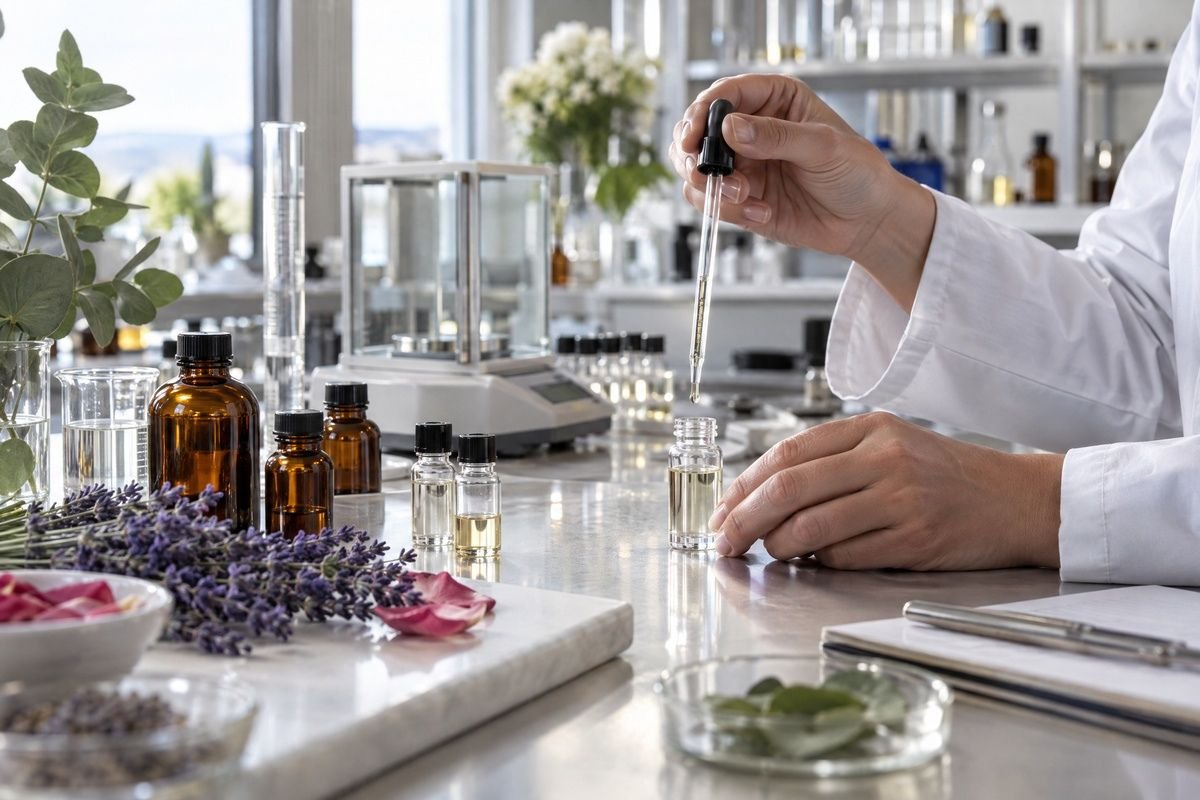
In commercial fragrance manufacturing, the natural-versus-synthetic debate often resolves into a practical answer : use both, strategically.
The logic of blending
A blended formulation strategy allows manufacturers to optimise across multiple dimensions simultaneously :
- Cost management – use synthetics for base and middle notes where consistency and volume matter, and reserve premium naturals for top notes or signature accords where their complexity adds perceptible value.
- Performance optimisation – pair the longevity and stability of synthetic musks or woody bases with the natural richness of essential oils in the top and heart of a fragrance.
- Regulatory navigation – where a natural ingredient faces IFRA restrictions (e.g. oakmoss), a synthetic alternative can maintain the olfactory profile while ensuring compliance.
- Marketing flexibility – formulations that include genuine natural ingredients can support “made with natural essential oils” claims, even when the overall formulation is predominantly synthetic.
Real-world examples
Perfumery compounds for personal care : A body lotion fragrance might use synthetic linalool and linalyl acetate for the bulk of a lavender accord, with a small percentage of genuine Lavandula angustifolia essential oil to add natural depth and support marketing claims.
Incense and agarbatti compounds : India’s incense industry – one of the world’s largest – routinely blends natural sandalwood, vetiver and floral attars with synthetic fixatives and fragrance extenders to produce affordable products at scale.
Home-care fragrances : Household product fragrances are almost entirely synthetic for stability and cost reasons, but some premium lines now incorporate natural citrus or eucalyptus oils as a point of differentiation.
The supplier’s role in blended formulation
A capable fragrance ingredient supplier supports blended strategies by offering both natural and synthetic products from a single source, simplifying procurement, logistics and quality management. This is where working with a supplier like Sakha International adds value – their portfolio spans essential oils, aroma oils, aromatic chemicals and perfumery compounds, enabling manufacturers to source both categories under one roof.
Supplier Evaluation and Purchasing Checklist
Before finalising a fragrance ingredient supplier, procurement teams should evaluate candidates against these criteria. This checklist applies whether you are sourcing natural essential oils, synthetic aroma chemicals or both.
Product range and portfolio depth
- ☐ Does the supplier offer both natural and synthetic ingredient categories?
- ☐ Can they supply across your required product types – essential oils, aroma oils, aromatic chemicals, perfumery compounds?
- ☐ Do they carry the specific ingredients your current and planned formulations require?
Quality assurance and documentation
- ☐ Does the supplier provide Certificates of Analysis (COA) with every batch?
- ☐ Do they offer GC-MS chromatograms for natural essential oils?
- ☐ Can they supply Safety Data Sheets (SDS) for all products?
- ☐ Do they provide IFRA Certificates of Compliance?
- ☐ Can they supply allergen declarations in line with EU 2023/1545 requirements?
Regulatory compliance
- ☐ Are their products formulated in accordance with current IFRA Standards?
- ☐ Can they support your compliance needs for target export markets (EU, US, GCC, ASEAN)?
- ☐ Do they maintain documentation for India’s BIS standards and FAFAI guidelines?
Supply reliability
- ☐ What are their standard lead times for key ingredients?
- ☐ Do they maintain buffer stock for high-demand items?
- ☐ Can they handle both small sample orders and bulk commercial quantities?
- ☐ What is their track record for on-time delivery?
Technical support
- ☐ Do they offer application support or formulation guidance?
- ☐ Can they provide samples for evaluation before purchase?
- ☐ Do they have an in-house quality-control laboratory?
Transparency and traceability
- ☐ For natural ingredients : can they provide origin, harvest date and extraction method information?
- ☐ For synthetic ingredients : can they identify the manufacturing facility and process?
- ☐ Do they have a sustainability policy or relevant certifications?
Manufacturer’s tip : Working with a supplier that offers a comprehensive portfolio – spanning natural and synthetic categories – simplifies vendor management and can reduce logistics costs. Contact Sakha International to discuss your specific ingredient requirements.
FAQs :
Q1 : Are natural fragrance ingredients safer than synthetic ones?
A : Not necessarily. Safety depends on the specific ingredient, its concentration and the application. Many natural essential oil components are potent allergens or sensitisers – oakmoss absolute, certain citrus furocoumarins and methyl eugenol are all restricted under IFRA Standards. Synthetic ingredients undergo the same rigorous safety evaluation through RIFM and IFRA. The safest approach is to evaluate each ingredient individually against current regulatory standards, regardless of its origin.
Q2 : Can manufacturers use 100 per cent natural ingredients in commercial fragrances?
A : It is technically possible but rarely practical at scale. All-natural formulations face challenges including higher cost, batch variability, limited palette (no marine, ozone or certain musk notes), potential regulatory restrictions and shorter shelf life for some materials. Some niche and luxury brands successfully market all-natural fragrances, but mass-market products almost universally rely on a blend of natural and synthetic ingredients.
Q3 : What is a nature-identical ingredient?
A : A nature-identical ingredient is a substance that is chemically identical to a compound found in nature but is produced through chemical synthesis. For example, synthetic linalool has the same molecular structure as linalool extracted from lavender or rosewood. Nature-identical ingredients offer the consistency of synthetics while replicating the specific aroma profile of a natural compound.
Q4 : How do IFRA Standards affect ingredient sourcing decisions?
A : IFRA Standards set maximum concentration limits for ingredients based on safety data. When a natural ingredient is restricted (e.g. due to allergen content), manufacturers may need to reformulate using a compliant synthetic alternative, or source a specially processed natural variant with reduced restricted-compound content. Staying current with IFRA amendments – and working with suppliers who maintain IFRA compliance documentation – is essential.
Q5 : What role does India play in the global fragrance ingredient market?
A : India is both a major consumer and a significant global supplier of fragrance ingredients. The country is one of the world’s leading producers of mint oils (menthol), lemongrass oil, sandalwood oil (plantation-grown), and several aroma chemicals. India’s essential oils market is projected to reach approximately USD 2.14 billion by 2025, while the aroma chemicals market was valued at around USD 299.2 million in 2025. The country’s growing domestic FMCG, personal care and fragrance compounding industries drive strong internal demand alongside exports.
Q6 : How should a manufacturer decide between natural and synthetic for a specific formulation?
A : Start with the end product’s requirements : target market regulations, price point, volume, shelf-life needs, marketing claims and customer expectations. Then evaluate each ingredient position in the formula against these criteria. For many products, a blended approach – using synthetics for consistency and cost efficiency and naturals for complexity and marketing value – delivers the optimal balance.
Choosing the Right Ingredients for Your Manufacturing Needs
The natural vs synthetic fragrance ingredients debate does not have a single winner. Both categories have legitimate roles in modern fragrance manufacturing, and the most successful manufacturers leverage each for its strengths.
Natural ingredients bring aromatic complexity, consumer appeal and heritage. Synthetic ingredients bring consistency, cost efficiency, creative freedom and scalability. A well-designed blended approach – informed by regulatory compliance, market requirements and sound technical judgment – is the pragmatic path for most manufacturers.
What matters most is working with a knowledgeable, reliable supplier who can provide both natural and synthetic ingredients with full documentation, consistent quality and responsive service.
Ready to source high-quality fragrance ingredients? Explore Sakha International’s complete product range – including essential oils, aromatic chemicals and perfumery compounds – or contact us directly to discuss your requirements.


Leave A Comment