
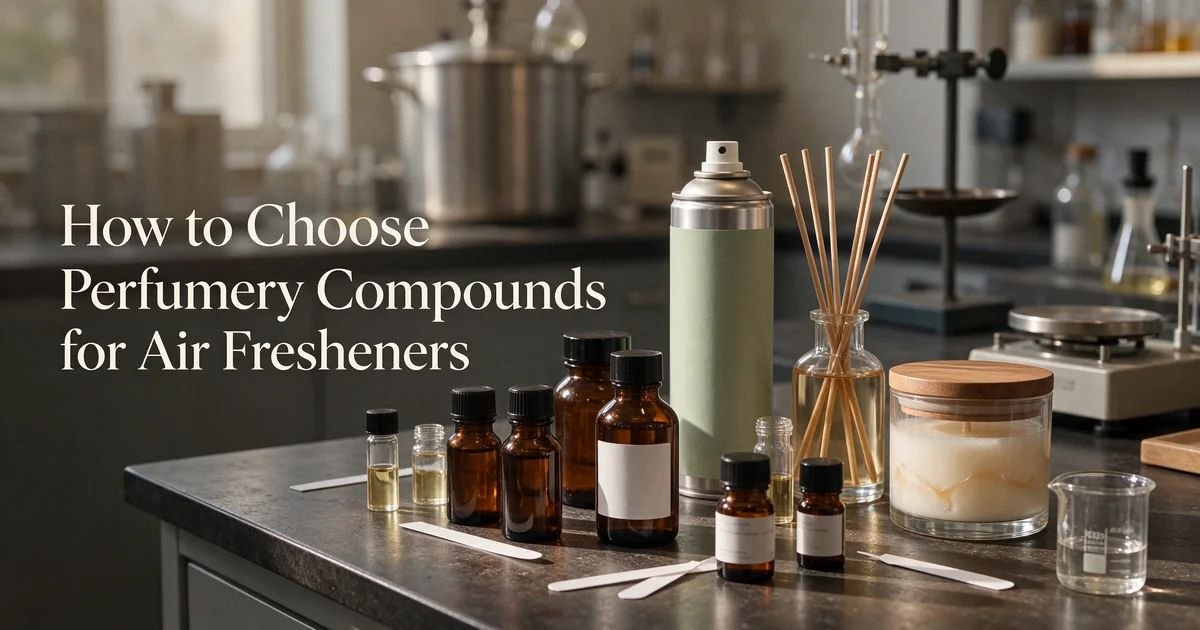
What Are Perfumery Compounds and Why Do They Matter in Air Fresheners?
A perfumery compound is a ready-to-use fragrance concentrate – a carefully balanced blend of aromatic chemicals, essential oils, absolutes, resinoids and functional ingredients such as fixatives and solvents. Unlike individual aroma molecules or raw essential oils, a finished compound is designed to deliver a specific olfactory profile – floral, citrus, woody, fresh, oriental or a layered accord – straight out of the drum.
For air freshener manufacturers, the perfumery compound is the single most consequential raw material decision in product development. It determines the scent character that consumers associate with the brand. It governs how quickly fragrance enters the air, how long it lasts, and how it behaves inside the chosen delivery system – whether that is a pressurised aerosol can, a gel matrix, a wick-fed plug-in or a set of reed diffuser sticks.
Choosing the wrong compound does not simply produce a less pleasant product. A fragrance that is chemically incompatible with its base can cause cloudiness, separation, corrosion or accelerated degradation. A compound formulated for fine fragrance may perform poorly in a water-based room spray. An air care formulation that ignores regulatory limits – such as those established by IFRA (the International Fragrance Association) – can create compliance problems across entire markets.
This guide walks manufacturers, formulators and procurement teams through the technical, regulatory and commercial considerations involved in selecting perfumery compounds for air fresheners, and explains what to look for in a fragrance supplier.
Air Freshener Formats and Fragrance Selection Considerations
Not every perfumery compound works in every air freshener format. The delivery mechanism determines which fragrance characteristics matter most – volatility profile, solubility, viscosity tolerance, propellant compatibility and regulatory category all shift from one format to the next.
Comparison Table : Air Freshener Types and Fragrance Requirements
| Format | Base System | Key Fragrance Requirements | Typical Challenges |
|---|---|---|---|
| Aerosol sprays | Solvent or water-based with propellant (LPG, DME or compressed gas) | High top-note impact; rapid diffusion; propellant compatibility; low residue; flammability compliance | Fragrance-propellant miscibility; valve corrosion; flash point and flame extension limits |
| Pump sprays | Water or water-alcohol blend | Good solubility in aqueous or hydroalcoholic base; balanced volatility; clarity in solution | Cloudiness or phase separation; microbial stability if water-based |
| Reed diffusers | Glycol ether, dipropylene glycol (DPG) or solvent blend with reeds | Steady capillary wicking; balanced evaporation across top, heart and base notes; solvent compatibility | Uneven note release; reed clogging from heavy resinous materials; solvent odour interference |
| Gel fresheners | Gelling agent (carrageenan, gellan gum or polyacrylamide) in water or glycol | Compatibility with gelling matrix; controlled slow release; colour stability | Syneresis (liquid weeping from the gel); fragrance migration; heat-induced melting |
| Plug-in and electric diffusers | Wick-fed liquid with low-wattage heater or fan-driven pad | Controlled volatilisation at operating temperature; thermal stability; wick compatibility | Thermal degradation of sensitive notes; inconsistent output as liquid level drops; wick saturation |
| Automatic dispensers | Concentrated aerosol or liquid cartridge with timed metering valve | High concentration; consistent dose per burst; cartridge material compatibility | Over-concentration in small spaces; cartridge seal integrity; valve clogging |
| Scented candles and wax melts | Wax (soy, paraffin, coconut or blends) | Heat stability; clean burn profile; adequate hot and cold throw; wick compatibility | Discolouration of wax; soot formation; fragrance flash point constraints |
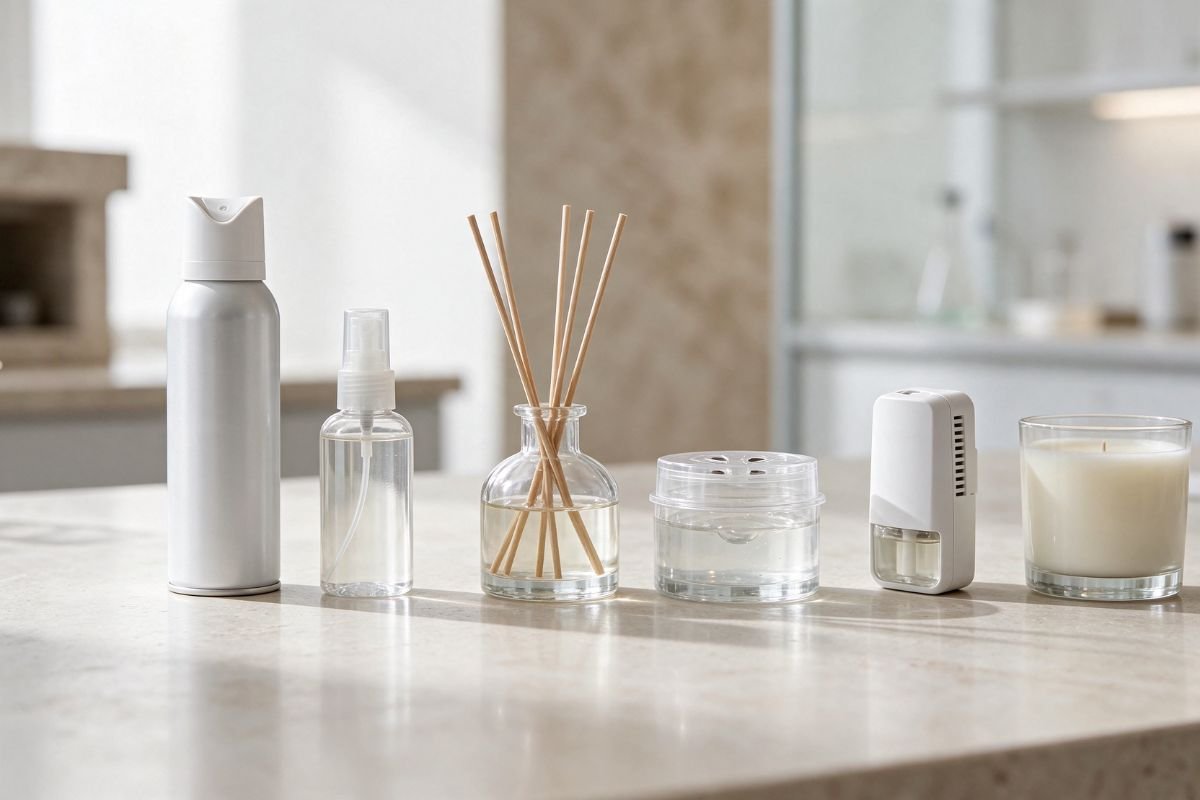
How Fragrance Selection Differs by Format
Aerosol and pump sprays demand compounds with strong top-note projection because the fragrance experience is immediate and brief. The compound must be fully miscible with the solvent or co-solvent system to prevent valve blockages and inconsistent spray patterns. For water-based aerosols, solubilisers or emulsifiers may be needed. Flame extension testing is mandatory for pressurised products – the compound contributes to the overall flammability of the formulation.
Reed diffusers rely on passive capillary action, so the fragrance must wick evenly through the reeds without clogging. Compounds with very heavy base notes or high resinoid content can slow wicking and bias the scent toward lighter top notes that evaporate first. The solvent – commonly a glycol ether or DPG blend – must dissolve the compound fully and itself have minimal competing odour.
Gel fresheners require compounds that remain stable within the gel matrix over weeks or months. Certain fragrance ingredients can interfere with gelation, cause syneresis (the gel weeping liquid) or accelerate colour changes. Stability testing in the actual gel base – not just in liquid solution – is essential before committing to production.
Plug-in and electric systems expose the compound to sustained low-level heat. Thermally sensitive ingredients – certain aldehydes, esters and naturals – may degrade, shift the scent profile or produce off-notes over time. The compound must also be compatible with the wick material and the plastic housing of the cartridge.
Automatic dispensers use concentrated formulations in sealed cartridges, so material compatibility with the cartridge, gaskets and metering valve is critical. The fragrance must deliver a consistent burst at each timed interval without settling or clogging.
Fragrance Intensity, Diffusion, Evaporation and Longevity
The performance of a perfumery compound in an air freshener is governed by four interrelated properties : intensity, diffusion, evaporation rate and longevity. Getting these right – for the specific delivery system – separates a commercially viable product from one that disappoints on the shelf or in the room.
Intensity and Diffusion
Intensity refers to the perceived strength of the fragrance at a given concentration. Diffusion describes how readily the scent molecules travel through air to fill a space. A compound may be intensely aromatic at the source but diffuse poorly, creating a localised experience rather than ambient freshness. For air care applications, high diffusion is typically more important than raw intensity.
Molecules with higher vapour pressure tend to diffuse more readily. Top notes – citrus terpenes such as limonene, light aldehydes, green accords – provide initial impact. Heart notes carry the character over the mid-life of the product. Base notes (musks, woods, resins) anchor the blend and extend perceived longevity, though they diffuse more slowly.
Evaporation Rate
In passive systems such as reed diffusers and gels, the evaporation rate of the compound directly determines the product’s functional life. If the top notes volatilise disproportionately fast, the scent profile shifts over time – a bright citrus opening may fade within days, leaving only a muted base.
Well-constructed air care compounds balance the evaporation curve so that the perceived character remains reasonably consistent from first use to end of life. This is a formulation decision, not something corrected by adding more compound to the base.
Longevity
Longevity in air fresheners is not measured the same way as in fine fragrance, where sillage and skin retention matter. Here, longevity means functional duration : how many days or weeks the product continues to deliver perceptible fragrance at the intended level. This depends on the compound’s volatility profile, the base system’s release mechanism, the ambient temperature and the size of the space.
Manufacturers should evaluate longevity under conditions that approximate real-world use – not only under controlled laboratory conditions – since temperature swings, air circulation and humidity all affect performance.
Base Compatibility, Solubility and Formulation Considerations
A perfumery compound that smells excellent on a testing strip may fail entirely in a finished product if it is incompatible with the base system. Compatibility testing in the actual formulation – not in a generic solvent – is a non-negotiable step in air freshener development.
Solubility and Clarity
Most air freshener bases are water-based, alcohol-based, glycol-based or solvent-based. The compound must dissolve completely in the chosen system at the intended use concentration. Incomplete solubility causes haziness, sedimentation or ring formation in transparent products. For water-based formulations, solubilisers such as polysorbates or PEG-based emulsifiers are frequently required, and the choice and dosage of solubiliser can itself affect the scent profile.
Material Compatibility
Fragrance compounds interact with packaging and delivery components. Certain terpenes and esters can soften or crack specific plastics. Aldehydes and some phenolics can cause discolouration or corrosion in metal aerosol cans or valve components. These interactions depend on the specific materials used – no blanket compatibility statement applies. Manufacturers should test the compound in contact with every material it will touch in the finished product : container walls, cap liners, valve gaskets, reed sticks and wick substrates.
Regulatory Compliance
IFRA (International Fragrance Association) publishes standards that set maximum permitted concentrations for specific fragrance ingredients, categorised by product type. Air freshener categories include aerosol sprays, non-spray air fresheners, reed diffusers and cartridge-based delivery systems. Each category may carry different concentration limits for the same ingredient.
A reputable fragrance supplier should provide an IFRA Certificate of Conformity for each compound, specifying which product categories the compound complies with and at what maximum concentration. This certificate attests to compliance with IFRA Standards but, as IFRA itself clarifies, does not replace a full safety assessment of the finished product. Manufacturers remain responsible for ensuring that the final formulation meets all applicable regulations in their target markets.
Supporting documentation to request from the supplier includes the Certificate of Analysis (COA), Material Safety Data Sheet (MSDS or SDS), allergen declaration and, where applicable, VOC content data.
Fragrance Stability and Performance Testing
Stability testing is where formulation assumptions meet reality. A fragrance compound that performs well at day one may discolour, lose its top notes or develop off-odours after weeks of storage or exposure to heat. Testing must be conducted in the finished formulation, not in the neat compound alone.
Key Stability Tests for Air Freshener Compounds

Accelerated aging subjects the finished product to elevated temperatures – commonly 40–50°C for defined periods – to simulate months of shelf life in a compressed timeframe. Industry protocols often use two weeks at 50°C to approximate roughly one year at ambient temperature, based on Arrhenius-type kinetic models, though the precise correlation varies by formulation.
Colour stability is assessed visually and instrumentally (spectrophotometry) before and after aging. Fragrance compounds containing vanillin, certain aldehydes or naturals with high phenolic content are more prone to yellowing or browning.
Odour evaluation by a trained panel or experienced perfumer compares the aged product against a fresh reference, assessing changes in character, intensity and the emergence of off-notes. GC-MS (gas chromatography–mass spectrometry) can identify specific molecular changes if off-notes are detected.
Physical stability checks include clarity, phase separation, viscosity changes (in gels), spray pattern consistency (in aerosols), wicking rate (in reed diffusers) and weight loss rate over time.
Material compatibility testing evaluates the compound’s interaction with packaging : plastic softening or cracking, metal corrosion, gasket swelling and label adhesion failures.
All testing should be conducted at the exact fragrance loading and in the exact base formulation intended for production. Changing the fragrance concentration, the solvent system or the gelling agent after testing invalidates the results.
Temperature, Packaging and Storage Considerations
Air fresheners are manufactured, warehoused, shipped and displayed across a wide range of environmental conditions. Products destined for tropical or subtropical markets – including much of India, Southeast Asia, the Middle East and Africa – face sustained high temperatures that accelerate fragrance degradation.
Temperature
Elevated temperatures increase the rate of evaporation, oxidation and chemical reaction within the formulation. Gel fresheners may soften or liquefy. Aerosol cans face increased internal pressure. Reed diffuser liquids may evaporate faster than intended, shortening product life. Compounds with thermally sensitive notes – certain citruses, light florals and some aldehydes – are more vulnerable.
Manufacturers should test products through temperature cycling (alternating high and low temperatures) to simulate real transit and storage conditions, not only steady-state heat.
Packaging
Packaging protects the fragrance from light, heat and oxygen – the three primary drivers of degradation. UV-blocking containers or opaque packaging reduce photodegradation. Airtight seals slow oxidation and prevent premature evaporation during storage.
The packaging material itself must be compatible with the compound. This should be verified during stability testing, not assumed from the packaging supplier’s generic specifications. Glass is generally inert, but plastic containers vary widely in their resistance to fragrance solvents and terpenes.
Storage of Raw Compounds
Perfumery compounds should be stored in tightly sealed, opaque containers in a cool, dry environment away from direct sunlight. Manufacturers purchasing in bulk should plan inventory turnover to avoid holding compounds beyond the supplier’s recommended shelf life, as even well-stored compounds will gradually lose top-note brightness and shift in character over extended periods.
How Manufacturers Should Evaluate Fragrance Samples
Receiving a fragrance sample from a supplier is the beginning of evaluation, not the end. A structured assessment process reduces reformulation cycles and production surprises.
Step 1 : Olfactory Assessment
Evaluate the compound on a scent strip and in-air at the intended use concentration. Assess it at multiple intervals – immediately after application, after 30 minutes, after several hours, and after 24 hours – to understand the dry-down and how the scent evolves. Compare against the brief and against competitive benchmarks.
Step 2 : In-Base Testing
Blend the sample into the actual production base at the intended loading percentage. Check for immediate clarity, any precipitation, and any change in viscosity or texture. For aerosols, test the spray pattern and valve function with the compound in the formulation.
Step 3 : Performance Testing
Test fragrance throw (the distance and intensity at which the scent is perceptible) under conditions that approximate the intended use environment. For reed diffusers, monitor wicking rate and scent consistency over days. For gels, assess surface-to-air release. For sprays, evaluate room fill and fade time.
Step 4 : Stability Screening
Conduct at minimum an accelerated stability screen – storage at elevated temperature for a defined period – before committing to bulk purchase. Check for colour changes, odour shifts, physical separation and any interaction with packaging materials.
Step 5 : Documentation Review
Before placing a bulk order, obtain and review the IFRA Certificate of Conformity for the relevant product category, the COA confirming batch specifications, the SDS for safe handling and storage, and the allergen declaration for labelling compliance.
How to Choose a Reliable Perfumery Compound Supplier
The supplier relationship in air freshener manufacturing is not a one-time transaction. Fragrance supply requires batch-to-batch consistency, responsive technical support and regulatory documentation that keeps pace with evolving standards. Here is what to evaluate.
Product Range and Air Care Expertise
A supplier that serves the air care industry specifically – not only fine fragrance or personal care – is more likely to understand the technical demands of different air freshener formats. Look for a supplier that offers perfumery compounds, individual aromatic chemicals, essential oils, solvents and fixatives under one roof, since air freshener formulation often requires adjustments across all these categories.
Sakha International, for example, supplies perfumery compounds, aromatic chemicals, essential oils, aroma oils, perfumery solvents, resinoids and refined glycerine for the air care industry from its base in Delhi. The company covers multiple air freshener formats including aerosol sprays, gel fresheners, reed diffusers, plug-in systems and scented candles. [Confirm with Sakha International : specific certifications held, in-house testing capabilities and named fragrance houses distributed.]
Documentation and Compliance
A reliable supplier provides, as standard, an IFRA Certificate of Conformity for the relevant product categories, a Certificate of Analysis (COA) for each batch, a Safety Data Sheet (SDS/MSDS), allergen declarations, and VOC content data where required. If a supplier cannot furnish these on request, that is a disqualifying concern.
Technical Support
The supplier should be able to advise on fragrance loading, solvent compatibility, evaporation profiles and regulatory compliance for different air freshener formats. This is particularly important for manufacturers entering a new format or a new export market. Sakha International’s air care page references formulation guidance on fragrance throw, solvent compatibility, evaporation rate, malodour masking and substrate compatibility. [Confirm with Sakha International : scope and availability of technical support services.]
Sample Availability and Lead Times
Evaluate whether the supplier can provide evaluation samples promptly and in quantities sufficient for lab-scale and pilot-scale testing. Understand standard lead times for bulk orders, minimum order quantities and whether the supplier carries stock or manufactures to order.
Consistency and Scale
Batch-to-batch consistency is critical. Ask about the supplier’s quality control processes, whether they provide retention samples and how they handle batch variation. Ensure the supplier can scale from trial quantities to full production volumes without quality drift.
Questions to Ask Before Bulk Purchasing
Before committing to a bulk order of any perfumery compound for air freshener production, manufacturers should obtain clear answers to the following questions.
1 – Is the compound compliant with IFRA Standards for my specific product category?
Request the IFRA Certificate of Conformity and confirm it covers the exact category – aerosol air freshener, non-spray air freshener, reed diffuser or cartridge system – at your intended use concentration.
2 – What is the recommended fragrance loading range for my base system?
The supplier should provide guidance, but the final loading must be validated in your formulation through testing.
3 – Has the compound been tested in a base similar to mine?
Ask whether the supplier has application data for your type of base system (water-based, solvent-based, gel, wax).
4 – What is the expected shelf life of the compound, and under what storage conditions?
Establish the supplier’s recommended storage temperature, container type and maximum storage duration.
5 – Can you provide a COA, SDS, allergen declaration and VOC data for this compound?
All four should be available as standard for any compound sold into the air care market.
6 – What is the minimum order quantity, and what are your standard lead times?
Understand whether the supplier stocks the compound or manufactures on demand.
7 – How do you ensure batch-to-batch consistency?
Ask about QC processes, analytical testing on each batch, retention samples and how deviations are managed.
8 – Can you support custom fragrance development or modification?
If you need a bespoke scent or adjustments to an existing compound, confirm whether the supplier has in-house perfumery or reformulation capability.
9 – What export documentation and regulatory support do you provide?
For manufacturers exporting finished products, the supplier should be able to assist with documentation for destination markets.
10 – Do you offer trial or pilot-scale quantities before bulk commitment?
A supplier willing to provide evaluation samples and pilot quantities demonstrates confidence in their product.
Practical Supplier and Product Selection Checklist
Use this checklist when evaluating a new perfumery compound or fragrance supplier for air freshener manufacturing.
- ☐ Define the target air freshener format and base system before requesting samples
- ☐ Request samples at the intended use concentration, not neat
- ☐ Conduct olfactory evaluation at multiple time intervals (immediate, 30 min, 2 hr, 24 hr)
- ☐ Test the compound in the actual production base for solubility, clarity and physical stability
- ☐ Run accelerated stability testing at elevated temperature for colour, odour and physical changes
- ☐ Test packaging compatibility : container, cap, valve, gasket, wick and reed materials
- ☐ Obtain the IFRA Certificate of Conformity for the relevant product category
- ☐ Obtain and review the COA, SDS, allergen declaration and VOC data
- ☐ Confirm the compound meets all regulatory requirements for target export markets
- ☐ Verify the supplier’s batch-to-batch consistency processes and retention sample policy
- ☐ Confirm minimum order quantities, lead times and pricing structure
- ☐ Assess the supplier’s technical support capability for formulation guidance
- ☐ Evaluate whether the supplier offers custom fragrance development or modification
- ☐ Establish clear terms for reorders, reformulation and complaint resolution
Ready to discuss your air freshener fragrance requirement? Contact Sakha International to request samples, technical specifications and pricing for perfumery compounds, aromatic chemicals and essential oils for air care applications.
FAQs :
Q1 : What is the difference between a perfumery compound and an aromatic chemical?
A : An aromatic chemical is a single molecule – such as linalool, limonene or vanillin – that contributes one specific scent characteristic. A perfumery compound is a finished blend of multiple aromatic chemicals, essential oils and functional ingredients, formulated to deliver a complete fragrance profile. Air freshener manufacturers typically purchase finished compounds rather than blending individual chemicals, unless they have in-house perfumery capability.
Q2 : Can the same perfumery compound be used in both aerosol sprays and gel fresheners?
A : Not necessarily. Each delivery format imposes different requirements on solubility, volatility, thermal stability and base compatibility. A compound that works well in a solvent-based aerosol may cause cloudiness or separation in a water-based gel. Always test the compound in your specific formulation and delivery system before scaling to production.
Q3 : What documentation should I expect from a fragrance supplier?
A : At minimum, request an IFRA Certificate of Conformity for your product category, a Certificate of Analysis (COA), a Safety Data Sheet (SDS/MSDS), an allergen declaration and, where relevant, VOC content data. A supplier that cannot provide these promptly should not be considered for bulk supply.
Q4 : How do I know if a perfumery compound is IFRA-compliant for my product?
A : The IFRA Certificate of Conformity issued by the fragrance supplier specifies the product categories the compound is compliant with and the maximum permitted use concentration. IFRA organises products into categories – for example, aerosol air fresheners, non-spray air fresheners, reed diffusers and cartridge systems may each have different limits. Confirm that the certificate covers your exact product type.
Q5 : What is the typical fragrance loading for air fresheners?
A : Fragrance loading varies widely by format and by the specific compound and base system. There is no universal percentage. The supplier may provide a recommended starting range, but the optimal loading must be determined through testing in your actual formulation. Excessive loading does not always improve performance and can cause stability or compatibility problems.
Q6 : How should I store perfumery compounds before use in production?
A : Store compounds in tightly sealed, opaque containers in a cool, dry area away from direct sunlight and heat sources. Follow the supplier’s recommended storage temperature and shelf life guidance. Plan inventory turnover to avoid holding compounds beyond their optimal use window.



Leave A Comment