
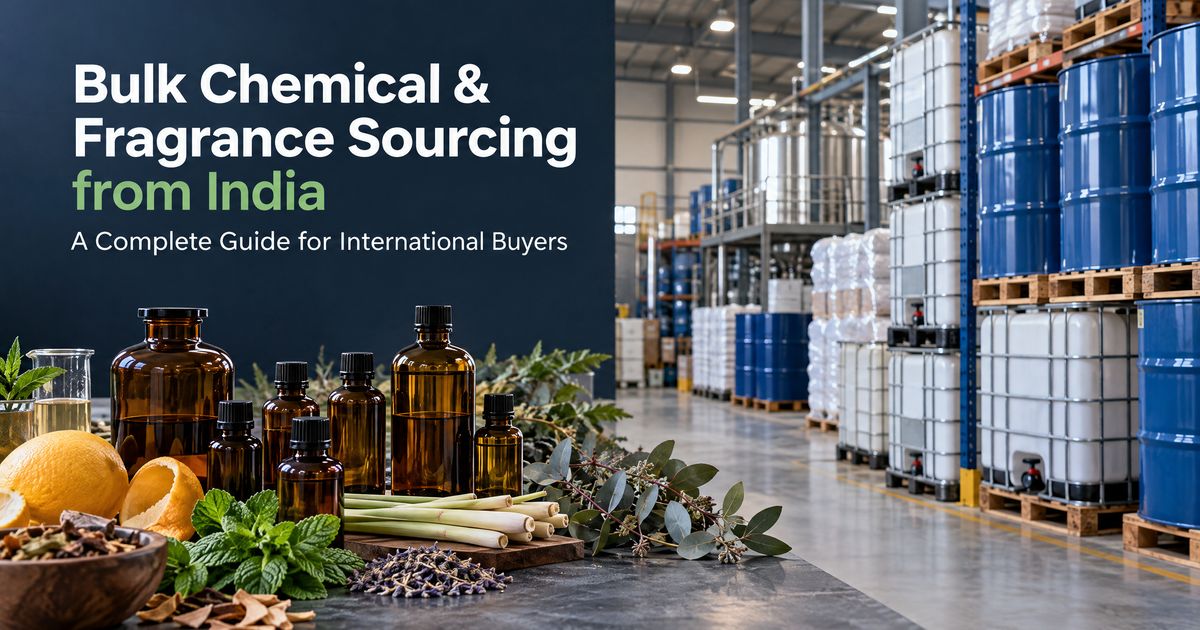
When an international procurement team needs a steady supply of fragrance ingredients or specialty chemicals, India is usually one of the first markets it looks at. The reasons are practical rather than promotional: a deep ingredient base that spans both natural aromatics and industrial chemistry, competitive pricing, and a long trading culture in which suppliers are used to handling export paperwork. For a perfume house in the Gulf, a cosmetics manufacturer in Europe, or a plastics processor in Southeast Asia, that combination is hard to ignore.
Sourcing across borders, however, raises questions that a domestic purchase never does. How do you confirm that a supplier is genuine and not simply a trading front? How do you pin down a specification so that the drum you receive in month six matches the sample you approved in month one? And which documents will your own customs authority actually ask for at the port?
This guide is written for buyers who want to purchase in volume and get it right the first time. It covers the product categories available, how to evaluate a supplier, the technical documentation that protects you, and the commercial mechanics of samples, minimum order quantities, packaging, shipping, Incoterms and payment. Where useful, it shows how an established Indian supplier such as Sakha International — founded in 2011 and based in Delhi — fits into that process, without overstating what any single supplier can promise.
Why International Buyers Source Chemicals and Fragrance Ingredients from India
India occupies an unusual position because it supplies both sides of the fragrance-and-chemical equation. A single market can offer natural raw materials — essential oils, attars, oleoresins and carrier oils — alongside the aromatic and specialty chemicals used in manufacturing. For buyers, consolidating categories with fewer suppliers reduces coordination overhead and shipping complexity.
Several practical factors draw international buyers to Indian suppliers :
- A broad ingredient base covering naturals, synthetics and industrial specialty chemicals in one country.
- Competitive pricing and flexibility on grades, pack sizes and order volumes.
- Suppliers who are accustomed to export documentation, sampling and international correspondence.
- Access to traditional aromatic products — attars, oudh and oriental notes — that are difficult to source elsewhere at scale.
None of this removes the need for due diligence. The real value of sourcing from India depends far less on the country than on the individual supplier you choose — their consistency, their documentation, and their willingness to be transparent. The rest of this guide is about making that choice well.
Types of Chemicals and Fragrance Ingredients Available from India
Indian suppliers typically organise their portfolio into fragrance materials, extracts and spice derivatives, and specialty or industrial chemicals. The categories below reflect the kind of range a diversified supplier like Sakha International carries, along with where each is commonly used.
Fragrance and aroma ingredients
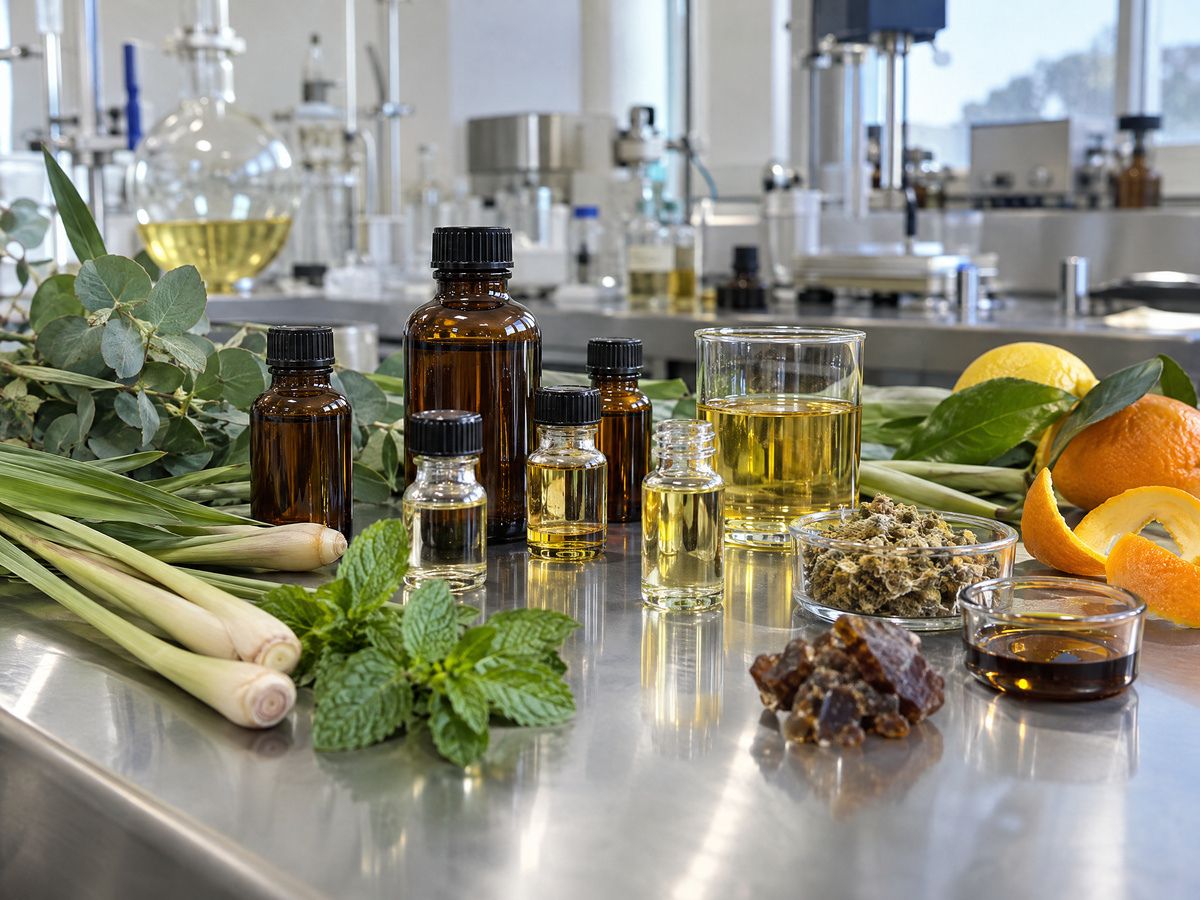
This group includes essential oils such as citronella, eucalyptus, lemongrass, orange and peppermint (mentha), along with aroma oils, aromatic chemicals, perfumery compounds, attars, absolutes and resinoids. These are the building blocks for fine fragrance, personal care, home care, fabric care and air care formulations, and for the oriental notes used in traditional perfumery.
Extracts, oleoresins and spice derivatives
Natural extracts and oleoresins — including oleoresin capsicum and paprika oleoresin — are concentrated flavour and colour materials used in food, nutraceutical and related applications. Spices and natural colors round out this segment for buyers in the food and flavour trade.
Carrier oils and solvents
Carrier oils are used to dilute concentrated aromatics for aromatherapy and cosmetic use, while perfumery solvents and paraffin oils serve as diluents and bases in fragrance manufacturing. Grade and purity matter here, since the carrier directly affects the finished product.
Specialty and industrial chemicals
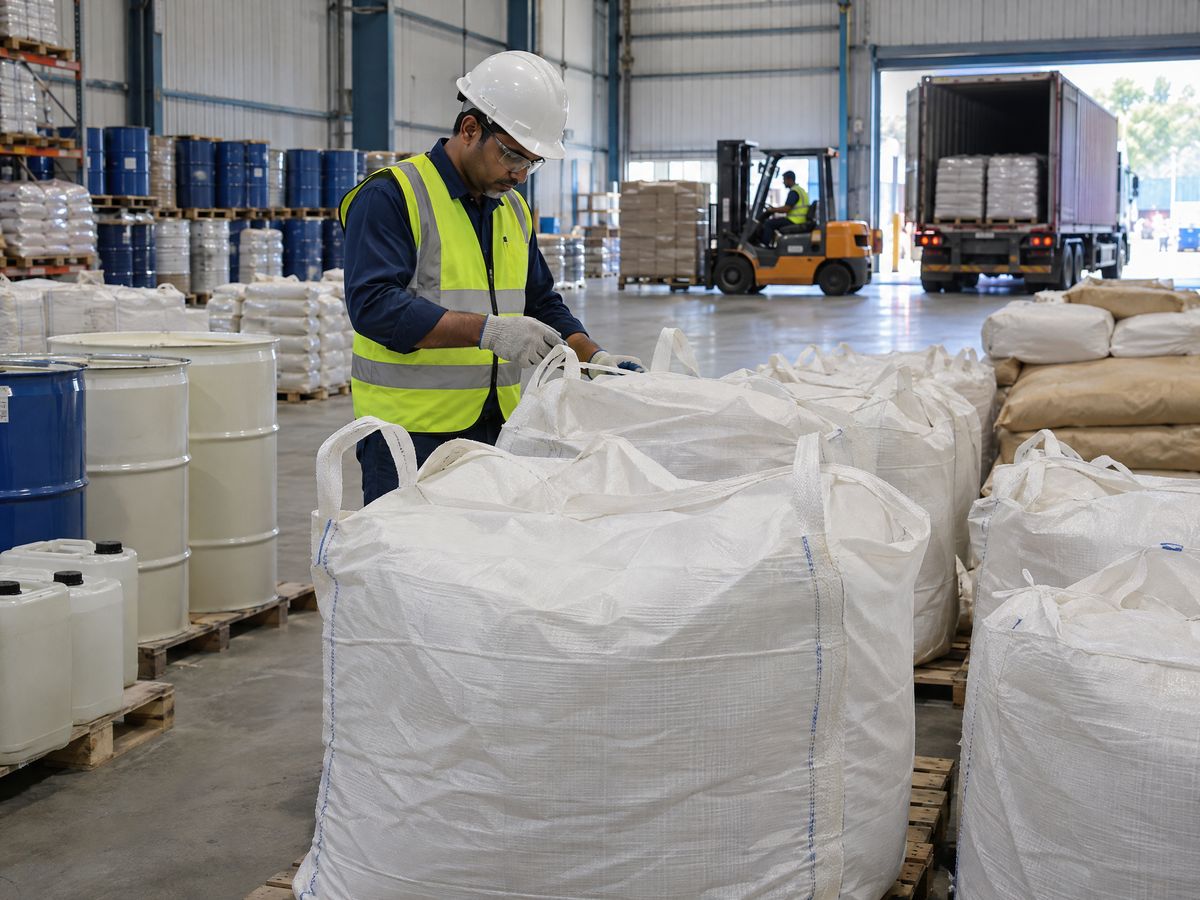
On the industrial side, metallic stearates — zinc, calcium, magnesium and aluminium stearate — act as lubricants, release agents and stabilisers across plastics, rubber, cosmetics and pharmaceuticals. The wider specialty chemicals range also includes zinc oxide, refined glycerine, stearic acid, PE wax and natural isomers. These are workhorse inputs for the masterbatch, personal care and skin care industries.
How to Find a Reliable Bulk Chemical Supplier in India
Price is the easiest thing to compare and the worst thing to decide on alone. A reliable supplier is one whose quality, documentation and communication hold up over repeat orders, not just on the first shipment. Use a consistent framework so you are comparing suppliers on the same terms, and keep a written record of what each one tells you.
The checklist below covers the areas that separate a dependable partner from a convenient quote.
| What to check | What good looks like |
|---|---|
| Company background | A verifiable trading history and a clear legal entity. Sakha International, for example, states it was founded in 2011 and is based in Delhi, India. |
| Product specialisation | Genuine depth in the specific products you need, not a generic catalogue that lists everything. |
| Supplier and brand relationships | Named sources or principals for the materials they resell, so you can trace origin. |
| Technical documentation | Ability to provide TDS, COA and SDS on request, per product and per batch. |
| Quality consistency | A stated approach to batch-to-batch consistency and retained samples. |
| Sampling | Willingness to send representative samples before a bulk commitment. |
| Communication | Prompt, specific replies to technical questions — a strong early signal. |
| Export capability | Experience preparing export documents for your destination and product type. |
| Commercial transparency | Clear terms on MOQ, lead time, packaging and payment, without evasiveness. |
A diversified exporter that positions itself as a manufacturer, wholesaler, distributor, trader and exporter — as Sakha International does — can simplify sourcing across several categories, but the same checks still apply to each product line. Request product specifications for the exact grades you need before you compare offers.
Product Specifications and Documentation
Documentation is where a sourcing relationship is either protected or exposed. Three documents do most of the work, and buyers should understand what each one is for.
- Technical Data Sheet (TDS) : describes the product’s identity, physical and chemical properties, typical grade characteristics and recommended applications. It tells you what the material is and how it behaves.
- Certificate of Analysis (COA) : reports the actual test results for a specific batch against the agreed specification. It tells you whether the material you are receiving meets spec right now.
- Safety Data Sheet (SDS): sets out hazard classification, safe handling, storage, transport and emergency information. It is essential for compliant shipping and workplace safety.
In short, the TDS is the general specification, the COA is the batch-specific proof, and the SDS is the safety and compliance reference. Ask for all three, and confirm that the COA is issued per batch rather than reused. Where relevant, also agree on purity and composition limits, grade selection, shelf life and storage conditions up front. Remember that documentation requirements vary by product, destination country and end application — a food-grade oleoresin and an industrial stearate will not carry the same paperwork.
Samples, MOQ and Bulk Purchasing
Samples and quality verification
A sample is the cheapest insurance you will buy in the whole transaction. Always evaluate a representative sample — and ideally test it against the agreed specification — before committing to a bulk order. Keep a retained portion of the approved sample so that, if a later batch is disputed, you have a reference to compare against. Agree in advance how quality discrepancies will be handled: what counts as out of spec, who tests, and what the remedy is. Settling this before the first order prevents most disputes later.
Minimum order quantity and bulk pricing
Minimum order quantity (MOQ) is the smallest quantity a supplier will produce or ship for a given product. It varies widely because it reflects production batch sizes, packaging formats and material cost — a high-value absolute will have a very different MOQ from a commodity stearate. Many suppliers distinguish between a trial order, meant to validate quality, and a commercial order at full volume. Bulk pricing usually improves with volume, order frequency and simpler packaging, but those are commercial details to confirm directly rather than assume. Ask each supplier to quote against your actual quantity, packaging and destination so the numbers are comparable.
Packaging and International Shipping
Packaging is product-specific, and treating it as an afterthought is a common and expensive mistake. Liquids such as essential oils and oleoresins are typically shipped in drums, cans or carboys with appropriate liners; powders and granular chemicals such as metallic stearates travel in lined bags or sacks. The right choice depends on the material’s chemistry, volume and sensitivity.
When you confirm packaging with a supplier, cover the points that affect the goods in transit :
- Leakage prevention and seal integrity for liquids.
- Moisture and light protection for sensitive materials.
- Clear labelling and batch identification on every unit.
- Suitability for your chosen container and loading method.
- Any temperature or shipping conditions the product requires.
- Dangerous-goods classification and packing where it applies.
Shelf life and transport stability also matter: a product that is stable in a warehouse may degrade on a long ocean route in a hot container. Confirm that packaging and transit conditions protect the material for the full journey, not just the first leg.
Export Documentation for International Buyers
Export and import paperwork falls into two groups : documents that accompany almost every Indian export, and documents that depend on your destination country, the product’s classification and your own requirements as the buyer.
Documents commonly prepared for an export shipment include :
- Commercial invoice and packing list.
- Shipping bill (the export declaration filed with Indian customs).
- Bill of lading (sea) or airway bill (air).
- Certificate of Analysis and Safety Data Sheet for the goods.
- Certificate of Origin, where the destination or a trade agreement requires it.
Destination-dependent documents vary far more : import permits, product-specific declarations, registration requirements and additional customs paperwork are set by the importing country and the nature of the product. Your own customs broker is the authority on what your port will require. For the Indian side of the process, the official references are the Directorate General of Foreign Trade (DGFT) and the Central Board of Indirect Taxes and Customs (CBIC), and chemical and cosmetic exporters also work with the CHEMEXCIL export promotion council.
Understanding Incoterms 2020
Incoterms 2020, published by the International Chamber of Commerce (ICC), are the standard three-letter rules that define where the seller’s responsibility ends and the buyer’s begins. They decide four things: who arranges and pays for carriage, where risk transfers from seller to buyer, who handles export and import clearance, and who bears which costs. They do not cover payment terms or transfer of ownership — those belong in your sales contract.
| Term | What it means | Buyer’s main responsibility |
|---|---|---|
| EXW | Ex Works — buyer collects from the seller’s premises. | Almost everything, including export clearance. |
| FCA | Free Carrier — seller delivers to a named carrier/point. | Main carriage and import clearance. |
| FOB | Free On Board — seller loads goods onto the vessel. | Sea freight, insurance and import. |
| CFR | Cost and Freight — seller pays freight to destination port. | Insurance and import clearance. |
| CIF | Cost, Insurance and Freight — seller adds minimum insurance. | Import clearance and onward transport. |
| CPT / CIP | Carriage (and Insurance) Paid To a named place. | Risk passes early; buyer handles import. |
| DAP / DPU | Delivered At Place / Unloaded at destination. | Import clearance and duties. |
| DDP | Delivered Duty Paid — seller delivers cleared for import. | Little; seller bears most cost and risk. |
New importers often default to CIF because it looks simple, but FOB can give you more control over freight and insurance if you have a reliable forwarder. Whichever term you choose, write it the correct way in the contract — for example, “CIF Jebel Ali Incoterms 2020” — so there is no ambiguity about the named port and the rule set.
International Payment Terms
Payment terms balance the seller’s need for security against the buyer’s need to protect working capital and verify goods. The common methods in international B2B trade are :
- Advance payment / bank transfer (TT) : simple and fast, but it places most of the risk on the buyer until the goods ship.
- Letter of Credit (LC) : a bank guarantees payment once the seller presents compliant documents, balancing risk between the parties. It adds cost and paperwork but suits larger or first-time orders.
- Documentary collection : banks handle documents against payment or acceptance, offering a middle ground between open account and an LC.
Whatever method you agree, pay attention to currency and exchange exposure, bank charges on both sides, and the accuracy of the commercial invoice, which drives customs valuation. For new relationships, phased payment milestones — a deposit, then balance against shipping documents — are a reasonable way to build trust. Do not assume a supplier accepts a particular method; confirm it in writing as part of the quotation.
Quality Control and Supplier Verification
Quality control is not a one-time check at onboarding; it is an ongoing discipline across every order. A practical programme includes verifying the COA against your specification for each batch, retaining samples for comparison, and inspecting packaging on arrival. For higher-value or regulated materials, independent third-party testing on receipt is a worthwhile safeguard.
Build traceability into the relationship so that any batch can be tracked back to its source, and agree a clear non-conformance procedure before problems arise: how a claim is raised, who tests, and what the remedy is. The real test of a supplier is not the first shipment but the tenth — consistent quality on repeat orders is what distinguishes a dependable partner.
Common Mistakes to Avoid
Most sourcing problems trace back to a short list of avoidable errors :
- Choosing a supplier on price alone, without weighing quality and reliability.
- Skipping technical specifications or accepting vague ones.
- Placing a bulk order before approving a representative sample.
- Failing to request or check COA, TDS and SDS documentation.
- Ignoring the import regulations of the destination country.
- Misreading Incoterms and assuming the seller covers more than they do.
- Not confirming product-specific packaging and transport restrictions.
- Leaving quality-acceptance criteria and dispute remedies undefined.
Each of these is easy to prevent with a written specification, an approved sample and a clear contract — the three documents that quietly protect every international order.
Why Consider Sakha International?
Sakha International was founded in 2011 and is based in Delhi, India. It positions itself as a manufacturer, wholesaler, distributor, trader and exporter working across both fragrance and specialty chemicals — a combination that lets buyers consolidate several categories with one supplier.
Its portfolio spans essential oils, aroma oils, aromatic chemicals, perfumery compounds, attars, absolutes, resinoids, carrier oils and oleoresins on the fragrance side, and metallic stearates, zinc oxide, refined glycerine, stearic acid, PE wax and related specialty chemicals on the industrial side. The company serves customers across cosmetics, perfumery, wellness and pharmaceutical applications, and emphasises quality and consistency with COA-backed supply.
For a sourcing enquiry, the most productive first step is to share your product, grade, quantity and destination so the team can prepare a relevant quotation. You can discuss your requirements or request samples through the contact page, or browse the full product range and industries served to confirm fit before you reach out.
International Buyer Enquiry Checklist
A complete enquiry lets a supplier prepare an accurate quotation on the first reply, instead of trading messages back and forth. Include the following:
| # | Information | Why it matters |
|---|---|---|
| 1 | Product name | Identifies the exact material. |
| 2 | Required grade | Grades differ in purity and price. |
| 3 | Technical specification | Defines what ‘acceptable’ means. |
| 4 | Intended application | Helps the supplier recommend the right grade. |
| 5 | Required quantity | Drives MOQ and pricing. |
| 6 | Sample requirement | Confirms quality before bulk. |
| 7 | Preferred packaging | Affects cost and transport. |
| 8 | Destination country and port | Sets documentation and freight. |
| 9 | Required documentation | COA, SDS, Certificate of Origin, etc. |
| 10 | Preferred Incoterm | Clarifies cost and risk split. |
| 11 | Expected delivery schedule | Aligns lead time and planning. |
| 12 | Special regulatory or quality needs | Flags compliance early. |
FAQs :
Q1. What products can I source from a bulk chemical supplier in India?
A diversified supplier can offer fragrance materials (essential oils, aroma oils, aromatic chemicals, perfumery compounds, attars, absolutes and resinoids), extracts and oleoresins, carrier oils, and specialty chemicals such as metallic stearates, zinc oxide, refined glycerine, stearic acid and PE wax. The exact range depends on the supplier; confirm availability for your specific grades.
Q2. How do I verify that an Indian chemical supplier is reliable?
Check the company’s trading history and legal entity, ask for TDS, COA and SDS per product, request a representative sample before committing to bulk, and judge how clearly and promptly they answer technical questions. Consistency across repeat orders is the strongest signal.
Q3. What is the difference between a COA, a TDS and an SDS?
A TDS describes the product’s general specification and properties; a COA reports the actual test results for a specific batch; and an SDS covers hazard, handling, storage and transport safety. You should request all three.
Q4. What does MOQ mean and why does it vary?
MOQ is the minimum order quantity a supplier will produce or ship. It varies by product because it reflects batch sizes, packaging and material cost — a high-value aromatic and a commodity chemical will have very different MOQs.
Q5. Which Incoterm should an international buyer choose?
It depends on how much of the logistics you want to control. CIF is simple because the seller arranges freight and insurance to the destination port; FOB gives you more control if you have a trusted freight forwarder. Always state the full term and named port, with ‘Incoterms 2020’, in the contract.
Q6. What export documents are involved in a shipment from India?
Typical documents include the commercial invoice, packing list, shipping bill, bill of lading or airway bill, COA and SDS, and a Certificate of Origin where required. Additional import documents depend on your destination country and the product.
Q7. How should I handle samples before placing a bulk order?
Evaluate a representative sample, test it against the agreed specification, and keep a retained portion for later comparison. Approve the sample and agree quality-acceptance criteria in writing before the bulk order ships.
Conclusion — Request an Export Quotation
Sourcing chemicals and fragrance ingredients from India rewards buyers who prepare. Define your specification, approve a sample, confirm documentation, agree the Incoterm and payment method, and verify quality on every batch — and most of the risk in international procurement simply disappears. The country offers one of the widest ingredient bases in the world; the outcome depends on choosing a transparent, consistent supplier and setting the relationship up correctly from the first order.
If you are ready to move from research to quotation, share your product, grade, quantity, destination and preferred Incoterm with Sakha International and request an export quotation. A complete enquiry means a faster, more accurate response — and a smoother first shipment.


Leave A Comment