
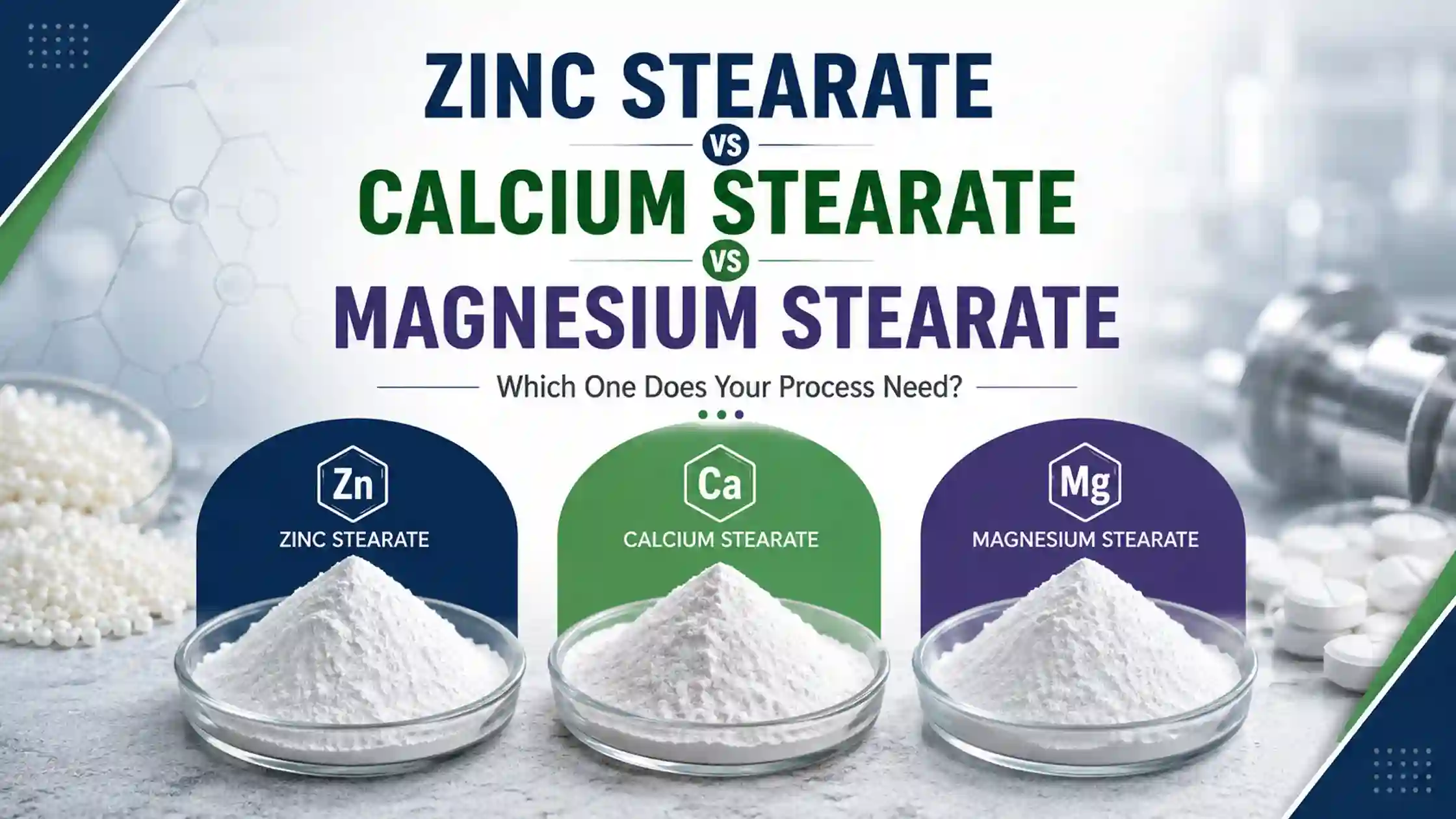
When selecting additives for manufacturing, understanding the differences between Zinc Stearate vs Calcium Stearate vs Magnesium Stearate is essential. These metallic stearates are widely used as lubricants, release agents, anti-caking agents, and processing aids across industries such as plastics, rubber, pharmaceuticals, cosmetics, paints, and construction materials.
Although they belong to the same family of metallic soaps, each stearate offers unique properties that make it suitable for specific applications. Choosing the right option can improve production efficiency, product quality, and overall process performance.
In this guide, we’ll compare Zinc Stearate vs Calcium Stearate vs Magnesium Stearate to help manufacturers determine the most suitable solution for their requirements.
What Are Metallic Stearates?
Metallic stearates are salts derived from stearic acid and metal ions. They are commonly used in industrial formulations due to their excellent lubrication, hydrophobicity, anti-sticking, and processing characteristics.
The most widely used metallic stearates include:
- Zinc Stearate
- Calcium Stearate
- Magnesium Stearate
Understanding the differences between Zinc Stearate vs Calcium Stearate vs Magnesium Stearate helps manufacturers optimize performance while controlling production costs.
Zinc Stearate vs Calcium Stearate vs Magnesium Stearate: Quick Comparison
| Property | Zinc Stearate | Calcium Stearate | Magnesium Stearate |
|---|---|---|---|
| Lubrication | Excellent | Good | Excellent |
| Water Repellency | High | High | Moderate |
| Release Properties | Outstanding | Good | Good |
| Thermal Stability | High | Very High | High |
| Pharmaceutical Use | Limited | Limited | Extensive |
| Plastic Processing | Excellent | Excellent | Moderate |
| Anti-Caking Ability | Moderate | Good | Excellent |
| Powder Flow Improvement | Good | Good | Excellent |
What Is Zinc Stearate?
Zinc stearate is a fine white powder widely recognized for its superior lubricating and mold-release properties. It is one of the most commonly used metallic soaps in industrial manufacturing.
Benefits of Zinc Stearate
- Excellent mold release agent
- Superior lubrication performance
- Reduces friction during processing
- Water-repellent properties
- Improves surface finish
- Prevents sticking in molds
Common Applications of Zinc Stearate
- Plastic manufacturing
- Rubber processing
- Paints and coatings
- Powder metallurgy
- Construction chemicals
- Masterbatches
- Thermoset molding compounds
In the comparison of Zinc Stearate vs Calcium Stearate vs Magnesium Stearate, zinc stearate is often preferred when exceptional release performance is required.
What Is Calcium Stearate?
Calcium stearate is one of the most versatile metallic stearates used across multiple industries. It functions as a lubricant, acid scavenger, stabilizer, and waterproofing agent.
Benefits of Calcium Stearate
- Cost-effective solution
- Excellent thermal stability
- Good lubrication properties
- Moisture resistance
- Acid scavenging capabilities
- Improved process stability
Common Applications of Calcium Stearate
- PVC processing
- Plastics manufacturing
- Construction materials
- Cement and concrete products
- Paper industry
- Paints and coatings
- Rubber compounds
When comparing Zinc Stearate vs Calcium Stearate vs Magnesium Stearate, calcium stearate is often selected for PVC stabilization and construction applications.
What Is Magnesium Stearate?
Magnesium stearate is a highly effective lubricant and flow-enhancing agent. It is particularly valued in pharmaceutical and cosmetic formulations.
Benefits of Magnesium Stearate
- Excellent powder flow properties
- Outstanding anti-caking performance
- Effective lubrication
- Uniform blending characteristics
- Improved manufacturing efficiency
Common Applications of Magnesium Stearate
- Pharmaceutical tablets
- Nutraceutical supplements
- Cosmetic powders
- Food processing
- Personal care products
In the discussion of Zinc Stearate vs Calcium Stearate vs Magnesium Stearate, magnesium stearate stands out for powder handling and tablet manufacturing.
Zinc Stearate vs Calcium Stearate vs Magnesium Stearate for Plastic Processing
Plastic manufacturers frequently use metallic stearates to improve processing efficiency.
Zinc Stearate
- Superior mold release
- Enhanced surface finish
- Reduced machine wear
Calcium Stearate
- Excellent acid scavenger
- Improves PVC stability
- Cost-effective processing aid
Magnesium Stearate
- Less common in large-scale plastic processing
- Suitable for specialty formulations
For plastic manufacturing, Zinc Stearate vs Calcium Stearate vs Magnesium Stearate often comes down to release performance versus stabilization requirements.
Zinc Stearate vs Calcium Stearate vs Magnesium Stearate for Pharmaceutical Manufacturing

The pharmaceutical industry requires precise control over powder flow and tablet production.
Zinc Stearate
Rarely used in tablet manufacturing.
Calcium Stearate
Used in selected pharmaceutical formulations.
Magnesium Stearate
Industry-standard tablet lubricant that enhances powder flow and prevents sticking during compression.
In pharmaceutical applications, the winner in the comparison of Zinc Stearate vs Calcium Stearate vs Magnesium Stearate is typically magnesium stearate.
How to Choose Between Zinc Stearate, Calcium Stearate, and Magnesium Stearate
The right choice depends on your manufacturing goals.
Choose Zinc Stearate if you need:
- Superior mold release
- High lubrication
- Better surface finish
- Efficient plastic and rubber processing
Choose Calcium Stearate if you need:
- Cost-effective performance
- PVC stabilization
- Moisture resistance
- Construction material enhancement
Choose Magnesium Stearate if you need:
- Improved powder flow
- Tablet lubrication
- Anti-caking properties
- Pharmaceutical-grade performance
Understanding Zinc Stearate vs Calcium Stearate vs Magnesium Stearate helps manufacturers select the most effective additive for their production process.
Why Quality Metallic Stearates Matter
Regardless of which metallic stearate you choose, product quality significantly impacts performance. High-purity metallic stearates offer:
- Consistent particle size
- Better dispersion
- Improved process efficiency
- Reduced defects
- Reliable product performance
Working with a trusted supplier ensures that your formulations deliver consistent results across batches.

Conclusion
The comparison of Zinc Stearate vs Calcium Stearate vs Magnesium Stearate shows that each product serves a unique purpose. Zinc stearate excels in lubrication and mold release, calcium stearate offers versatility and PVC stabilization, while magnesium stearate dominates pharmaceutical and powder-processing applications.
By understanding the strengths of each metallic stearate, manufacturers can improve production efficiency, product quality, and operational performance. Selecting the right metallic stearate ultimately depends on your industry, formulation requirements, and desired end-product characteristics.





Leave A Comment