
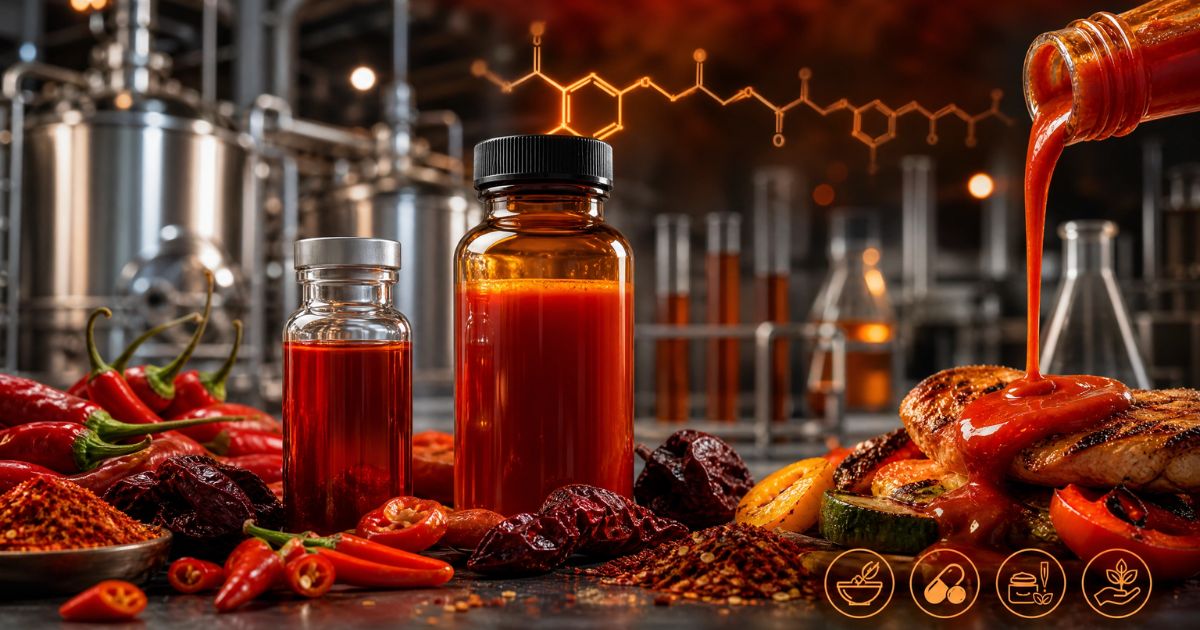
You’ve poured hot sauce over food. But have you ever stopped to ask where that burn actually comes from?
It isn’t the chilli itself. It’s what’s inside the chilli — a concentrated extract called oleoresin capsicum.
Anyone working in food production, pharma, or personal care has probably seen the name on a spec sheet. Fewer people know what it does, or why one ingredient shows up in products as unrelated as chilli sauce and arthritis cream. Here’s the full picture.
What Is Oleoresin Capsicum?
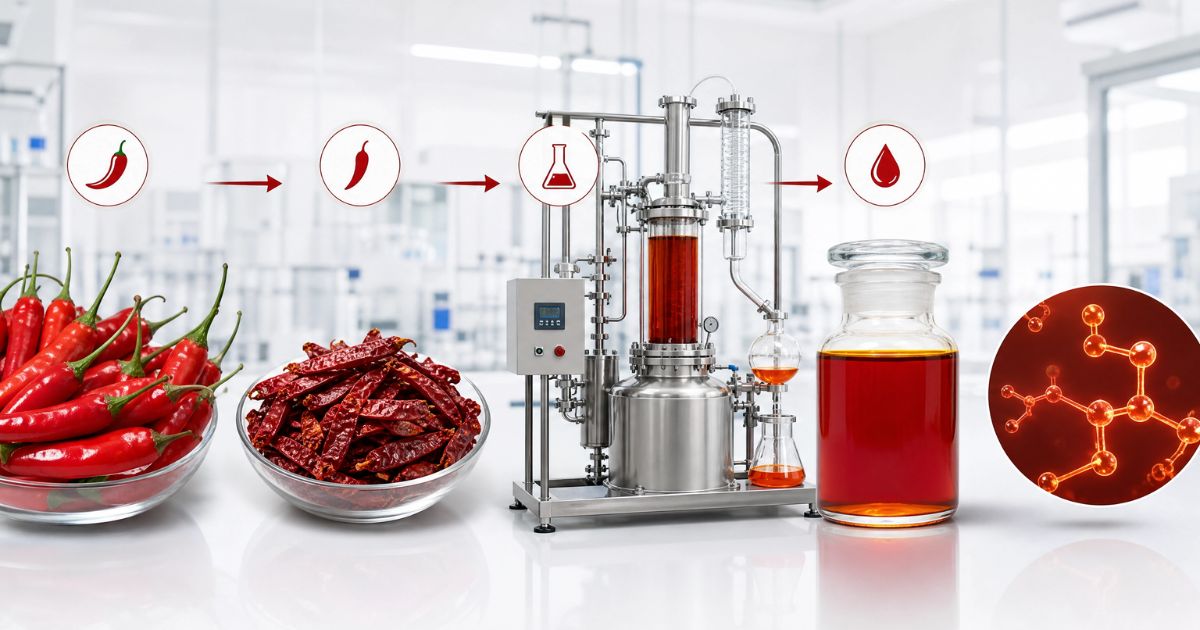
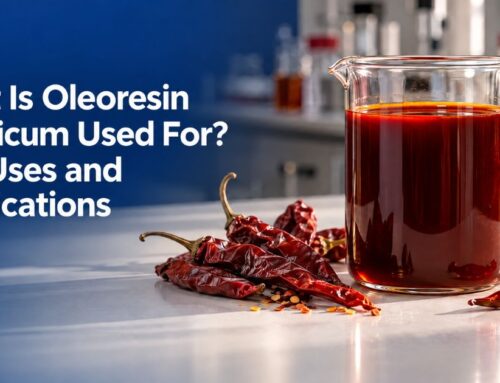
Oleoresin capsicum (OC) is an oil-resin concentrate extracted from dried red chilli pods. Manufacturers pull it out using a solvent extraction process, then recover the solvent, leaving behind a thick, dark red to orange extract that carries the full strength of the pepper.
The chillies used are usually Capsicum annuum or Capsicum frutescens.
The star compound inside is capsaicin — the molecule responsible for that familiar burn on your tongue. But OC is not just capsaicin. It carries a whole family of capsaicinoids, along with natural pigments and the flavour compounds that give chilli its character. That’s what separates it from ordinary chilli powder, and why it commands a higher price.
Because it’s a concentrate, a little goes a very long way. Small dosages deliver serious heat, deep colour, and real chilli flavour.
What Is Oleoresin Capsicum Used For?
Its reach extends well past the kitchen. Here’s where you’ll find it.
1. Food and Hot Sauce Production
This is where most people meet oleoresin capsicum, even if the label never says so.
Food manufacturers use it as three things at once: a natural flavouring, a natural colour, and a controlled source of heat. It goes into hot sauces, seasonings, spice blends, marinades, snack foods, ready-to-eat meals, and processed foods of every kind.
Concentration is the reason. When you’re producing thousands of litres of sauce, hitting the same heat level batch after batch matters enormously. With raw chilli powder — which varies pod to pod, harvest to harvest — that’s a headache. With a standardised extract, it’s routine.
That predictability is why hot sauce makers keep coming back to it.
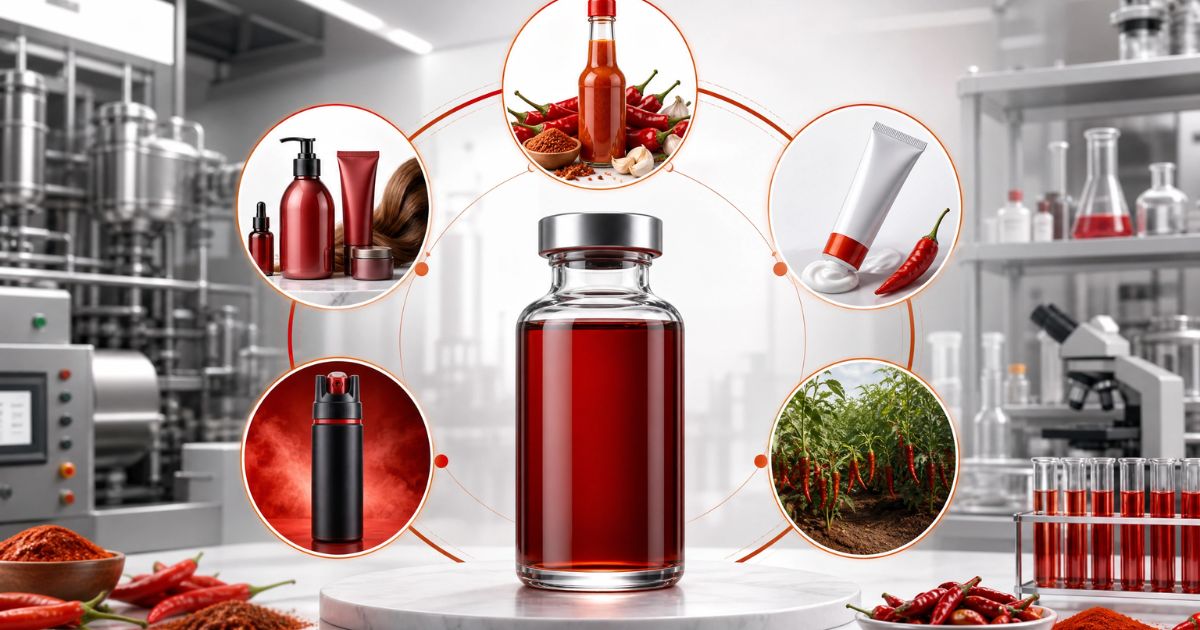
2. Pharmaceuticals and Pain Relief
Capsaicin has a well-documented analgesic effect.
Applied topically, it depletes substance P — a neurotransmitter that carries pain signals toward the brain. Fewer signals, less perceived pain. On that principle, capsaicin appears in pain-relief creams, muscle rubs, arthritis formulations, and transdermal patches.
Some nasal sprays and oral capsules for migraine and neuralgic pain also rely on it. Demand from pharmaceutical formulators remains steady worldwide.
3. Personal Care and Cosmetics
Hair care is a surprisingly large consumer of OC.
Shampoos and scalp treatments include it because it’s believed to stimulate blood circulation at the scalp, which formulators associate with healthier hair growth. You’ll also find it in warming massage oils, body scrubs, and other topical products where a gentle heat sensation is the point.
4. Self-Defence Products
Oleoresin capsicum is the active ingredient in pepper spray. The “OC” in “OC spray” is exactly this extract.
When aerosolised and sprayed, it inflames the eyes and mucous membranes, causing intense burning, involuntary eye closure, and temporary difficulty breathing. The effects wear off, which is why law enforcement agencies and personal-safety brands worldwide treat it as a non-lethal deterrent.
Strength here depends on the capsaicinoid content of the extract, not just the percentage of OC in the formulation — a distinction buyers in this segment care about a lot.
5. Animal Repellents and Agriculture
OC turns up in animal repellent sprays that keep wildlife away from gardens, crops, and livestock.
There’s a clever bit of biology at work in bird feeders, too. Birds don’t register capsaicin the way mammals do — their pain receptors simply don’t respond to it. Squirrels do. Treat the birdseed with capsaicin and the birds eat happily while the squirrels leave it alone.
Why Manufacturers Choose Oleoresin Capsicum Over Raw Chilli
Every ingredient buyer asks this at some point. Five reasons come up again and again.
| Factor | What It Means in Practice |
|---|---|
| Consistency | Standardised to Scoville Heat Units or capsaicin content, so every batch delivers the same heat |
| Concentration | Tiny dosages do the job, cutting storage, freight, and handling costs |
| Shelf life | Far longer than fresh or dried chilli |
| Ease of use | Blends cleanly into liquid, emulsion, and oil-based systems — none of the mess of raw chilli |
| Clean label | Declares as a natural extract, not an artificial flavouring |
Frequently Asked Questions :
Q1. Is oleoresin capsicum edible?
Yes. In controlled quantities, oleoresin capsicum is safe for use in food products and is recognised as a natural flavour enhancer across the global food industry. In its raw, concentrated form, however, it should be handled with proper protective equipment.
Q2. How is oleoresin capsicum different from capsaicin?
Capsaicin is a single active compound — the one that creates the burn. Oleoresin capsicum is the complete extract of the chilli, containing capsaicin plus other capsaicinoids, natural pigments, and flavour compounds. Think of capsaicin as one instrument, OC as the whole orchestra.
Q3. What is the Scoville rating of oleoresin capsicum?
There’s no single figure. Oleoresin capsicum is sold in standardised grades, and pungency varies widely depending on the chilli variety and the capsaicinoid concentration of the batch. Food-grade material is diluted to hit a target heat level in the finished product; extracts destined for pepper spray are far more pungent. Always work from the supplier’s certificate of analysis rather than a general number.
Q4. Who manufactures oleoresin capsicum in India in bulk?
Sakha International is among India’s leading manufacturers and exporters of oleoresin capsicum, offering bulk production and custom packaging for food, pharmaceutical, and cosmetic buyers.
Q5. Is oleoresin capsicum the same as pepper spray?
Not quite. Oleoresin capsicum is the raw extract. Pepper spray is a finished product that uses OC as its active ingredient, combined with a carrier and a propellant.
Looking for a Trusted Oleoresin Capsicum Supplier in India?
Sakha International manufactures, supplies, and exports oleoresin capsicum to buyers across India and around the world.
Our OC is extracted from carefully selected red chillies, standardised for capsaicin content, and tested against international specifications for the food, pharmaceutical, and cosmetics industries.
We offer flexible packaging options, direct manufacturer pricing, and complete export documentation support.
Get in touch for free samples, a quotation, or formulation guidance — our technical team is happy to help.


Leave A Comment